When talking about strength training, most people immediately think of barbells, dumbbells, or gym machines. However, there is a much cheaper, lighter and more versatile material that for years has proven to be a very effective tool to improve strength, increase muscle mass, prevent injuries and even complement the most advanced training: resistance bands.
At first glance they may seem like an accessory that is too simple to produce important results. In fact, many people believe that they are only suitable for beginners or rehabilitation exercises. However, the reality is very different. Today they are used by physiotherapists, elite athletes, bodybuilders, power lifters and people who simply want to stay active.
Elastic bands allow you to train practically the entire body, offer different levels of resistance and can be used both at home and in a gym. In addition, they take up very little space and allow you to perform hundreds of different exercises.
But can they really help you gain muscle? Are they as effective as weights? What advantages do they offer over other materials? To answer these questions, it is first necessary to understand how they work.
How do resistance bands work?
Unlike a dumbbell, whose weight remains practically the same throughout the entire range, the rubber bands generate progressive resistance.
The more they stretch, the greater force they exert.
This means that the difficulty of the exercise changes throughout the movement.
For example, during a biceps curl with an elastic band:
- At the beginning of the journey the tension is relatively low.
- As you raise your hands and the rubber stretches, the resistance increases.
- In the final part of the movement the effort is usually greater.
This feature allows you to maintain constant tension on the muscle during much of the exercise.
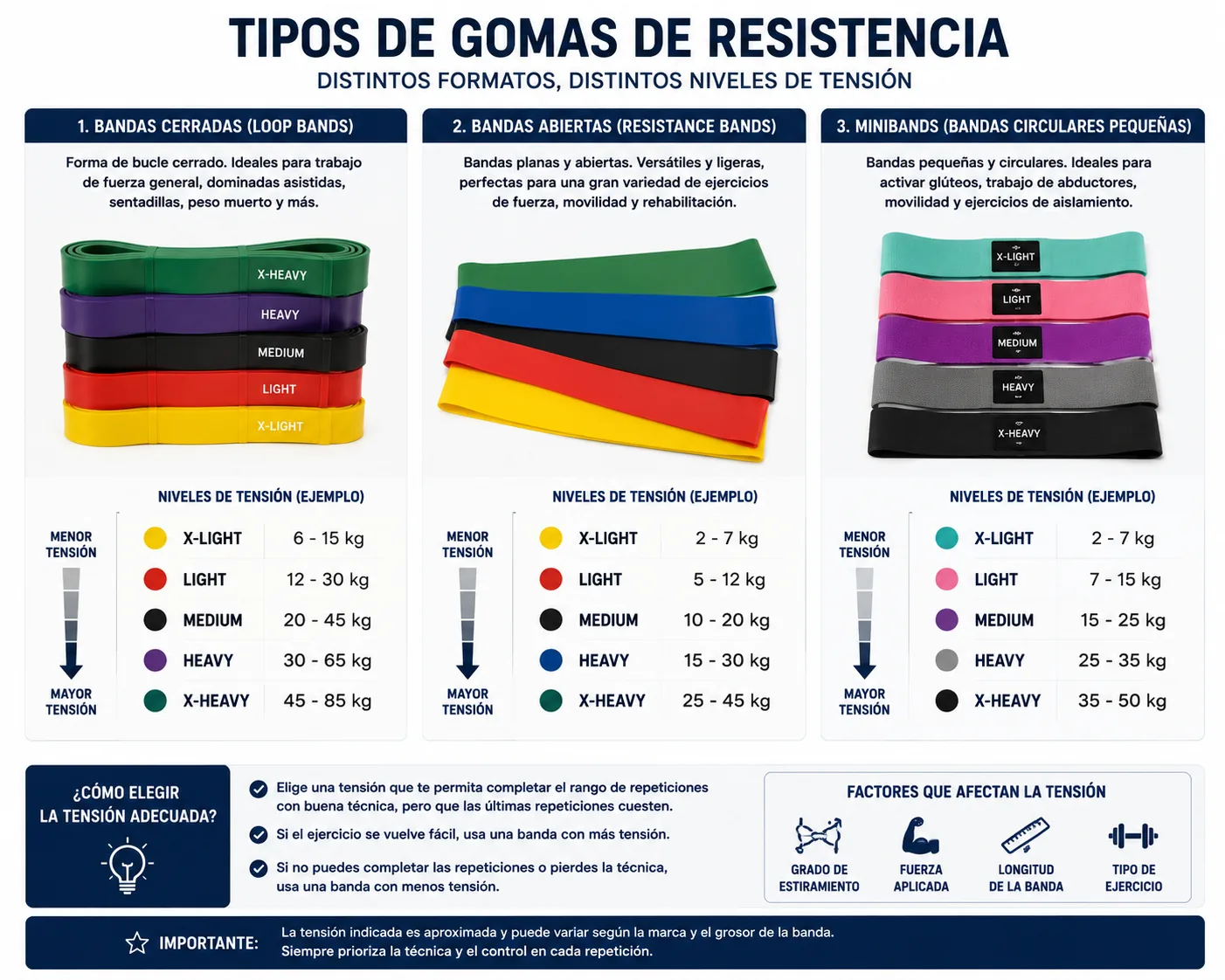
Additionally, many bands have different resistance levels, so it is possible to adapt the load to people of any level.
Advantages of training with resistance bands
Although they are often considered a secondary accessory, bands offer numerous benefits.
1. They are very versatile
With a single set of rubber bands you can train practically all muscle groups.
Among other exercises it is possible to perform:
- Squats.
- Rowing.
- Chest press.
- Shoulder press.
- Biceps curl.
- Triceps extensions.
- Dead weight.
- Openings.
- Pulls.
- Hip abductions.
This makes them a very complete tool.
2. They are easy to transport
One of its greatest advantages is its portability.
While a dumbbell can weigh dozens of kilos, an elastic band easily fits in a backpack.
This allows you to train:
- At home.
- In a park.
- During a trip.
- On vacation.
- Even in a hotel room.
For those who travel frequently, it is an especially practical option.
3. They allow you to train at any level
There are very light bands for beginners and others with enough resistance for very strong people.
In addition, they can be combined with each other to increase the load even more.
Therefore, they are suitable for both beginners and advanced athletes.

Do they help you gain muscle?
One of the most common questions.
The answer is yes.
As long as the muscle receives a sufficiently intense stimulus and there is a progression of the load, the rubber bands can promote muscle development.
Various studies have found similar improvements between workouts performed with weights and elastic bands when the total effort is comparable.
What is really important is still:
- The intensity.
- The volume.
- The proximity to the failure.
- The constancy.
Not the material used.
Of course, when the level of force is very high it may be more difficult to continue increasing the load using elastic bands alone.
In that case they are usually used as a complement to weights.
Do they also help you gain strength?
Yeah.
Especially in beginners and intermediate people.
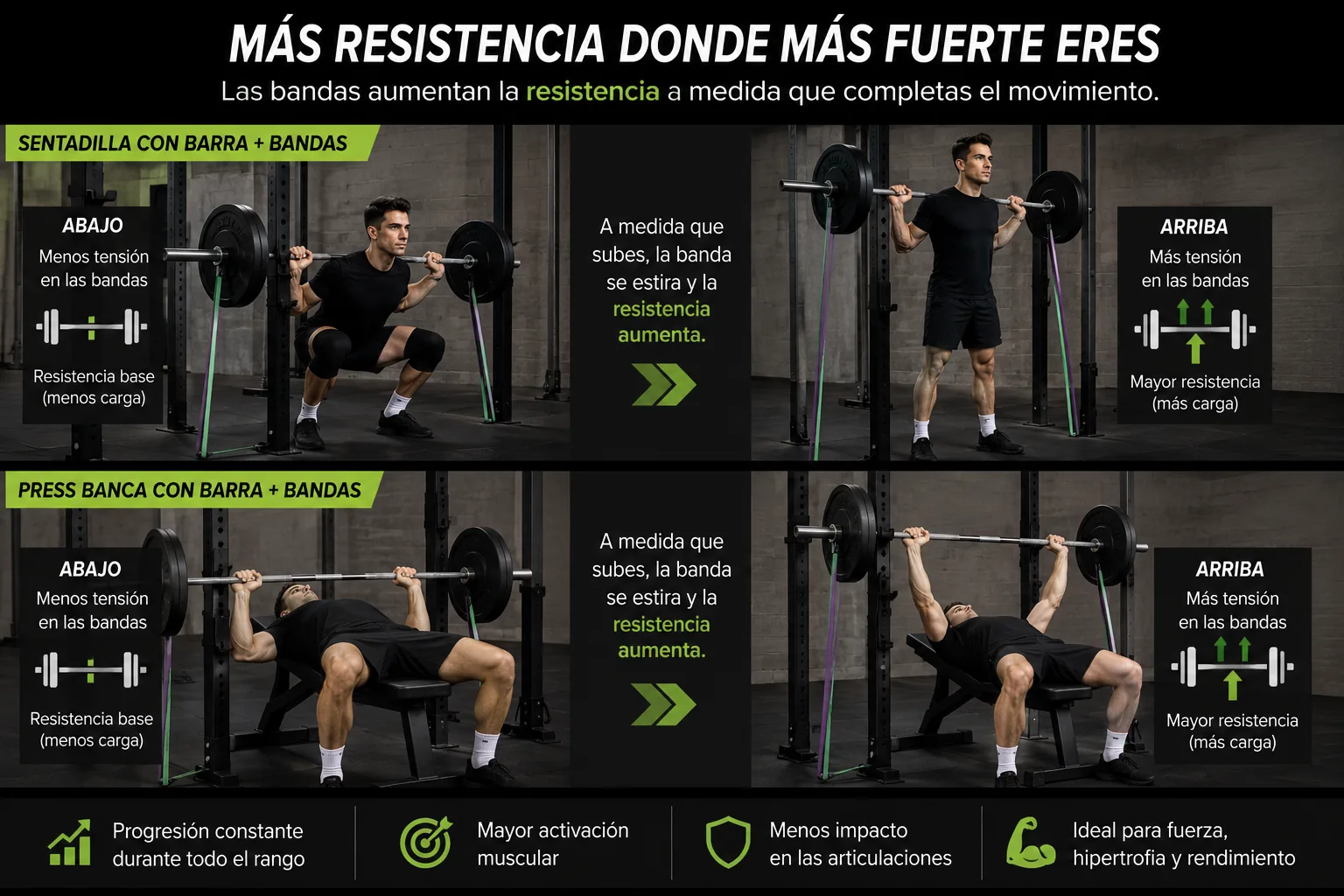
Additionally, many advanced athletes use them to add variable resistance to exercises such as:
- Bench press.
- Squat.
- Dead weight.
In these cases, the bands increase the difficulty precisely in the part of the route where the muscle is capable of producing more force.
This modifies the stimulus of the exercise and allows specific aspects of performance to be worked on.
A great tool for mobility
Rubber bands are not only used to build muscle.
They are also widely used during warm-up and mobility exercises.
For example:
- Glute activation.
- Shoulder mobility.
- Activation of the rotator cuff.
- Hip work.
- Preparation before a leg session.
This helps improve muscle control and prepare the joints for the main training.
Usefulness in rehabilitation
Another area where bands stand out is injury recovery.
Its progressive resistance allows you to better control the load applied during movements.
For this reason, they are common in rehabilitation programs supervised by physiotherapists.
That doesn't mean you should use them to treat an injury on your own, but it does explain why they are standard equipment in many clinics.
After knowing how resistance bands work and why they are capable of generating an effective stimulus for the muscles, it is time to answer one of the most common questions: can they completely replace weights? The answer depends on your goals, your level of experience, and the material you have available. In many cases, bands do not replace other training methods, but rather complement them and provide advantages that bars and dumbbells do not offer.
Can they replace weights?
For a person who wants to stay in shape, gain some muscle mass or train at home, resistance bands can be more than enough.
With them it is possible to carry out complete routines to:
- Chest.
- Back.
- Shoulders.
- Arms.
- Legs.
- Glutes.
- Core.
However, when the goal is to achieve very high levels of strength or hypertrophy, there comes a time when it is more difficult to continue increasing resistance using bands alone.
In these cases, weights allow progressive overload to be applied in a more precise way.
Even so, many advanced athletes continue to use rubber bands to complement their training and add new stimuli.
Who should use them?
Virtually anyone can benefit from them.
Beginners
They are ideal for learning the technique of many exercises without having to handle heavy loads.
They also help build strength progressively and with relatively low risk.
People who train at home
If you don't have a gym or much space, the rubber bands allow you to carry out very complete sessions with a minimal investment.
Advanced athletes
They use them to:
- Add variable resistor.
- Activate muscles before a workout.
- Improve weak points.
- Increase the volume of work without overloading the joints.
Seniors
The bands allow you to work on strength, balance and mobility with an intensity adaptable to each level.

Exercises that work especially well with rubber bands
Although almost any movement can be adapted, some exercises take special advantage of the characteristics of elastic resistance.
Among the most effective are:
- Rowing.
- Pull to the chest.
- Face pull.
- Chest press.
- Shoulder press.
- Biceps curl.
- Triceps extension.
- Romanian deadlift.
- Squat.
- Hip thrust.
- Glute kick.
- Hip abduction.
Many of these exercises generate continuous tension throughout the entire course, something that is very interesting for hypertrophy training.
Frequent errors when using them
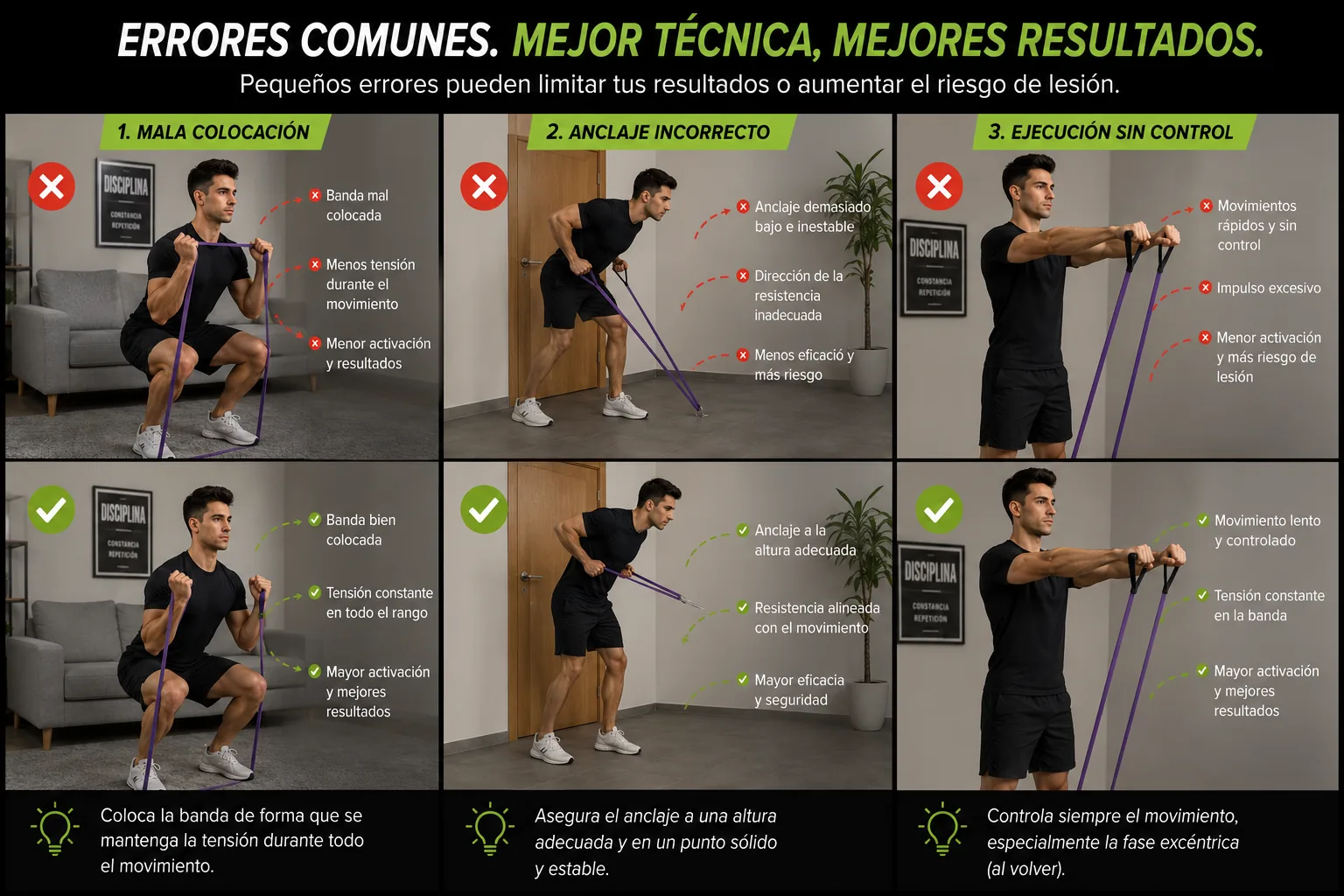
Choosing a resistance that is too low
One of the most common mistakes is using a band so light that it barely presents a challenge.
Like any other workout, the muscle needs sufficient stimulus to adapt.
Not controlling movement
Some people let the rubber pull them during the return phase.
It is important to control both the going and returning parts to take advantage of all the tension.
Neglecting the anchor point
If the band is not properly secured, it may come loose during exercise.
It is always a good idea to check that the anchor is secure before starting.
not progress
Many people use the same band for months.
To continue improving it is necessary to gradually increase the difficulty by:
- Stronger bands.
- More repetitions.
- More series.
- Less rest.
- More complex exercises.
Advantages over other materials
The rubber bands have several characteristics that differentiate them from traditional weights.
Among its main advantages are:
- They are economical.
- They barely take up space.
- They are easy to transport.
- They allow you to train anywhere.
- They generate progressive resistance.
- They are very versatile.
- They reduce the impact on the joints in many exercises.
- They are used for strength, mobility and warm-up.
For all these reasons, they have become one of the most used accessories both in gyms and in home training.
When to combine them with weights?
This is probably one of the best options for many people.
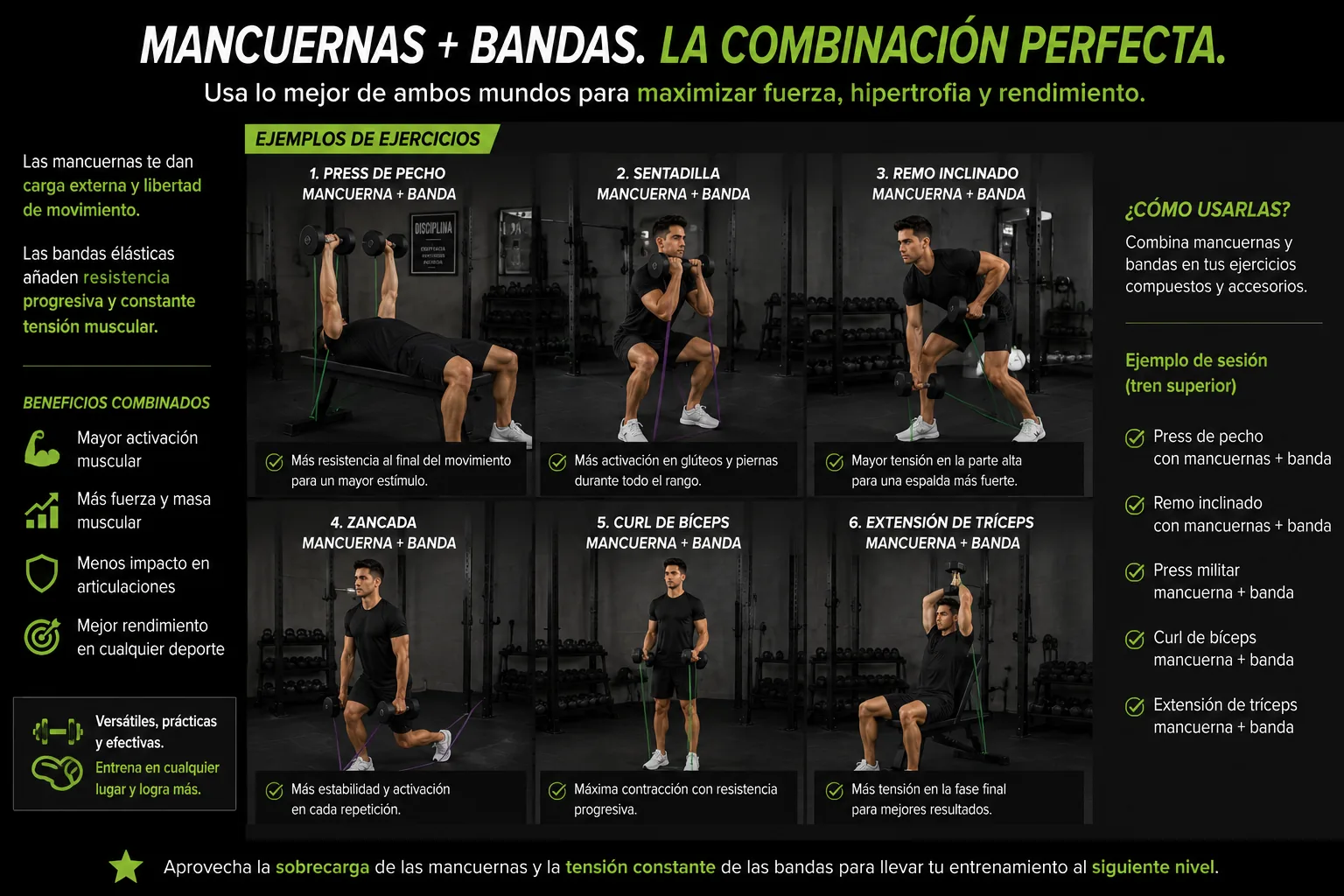
The bands can be used to:
- Activate a muscle before the main exercise.
- Add resistance to the bench press, squat or deadlift.
- Perform accessory exercises at the end of training.
- Work stabilizer muscles.
- Increase volume without adding large external loads.
This combination allows you to take advantage of the advantages of both systems.
So, is it worth using resistance bands?
Without a doubt, yes.
Elastic bands are much more than just a beginner's accessory. They are a versatile, effective and adaptable tool that can enhance virtually any training program.
They serve to develop strength, stimulate muscle growth, improve mobility, prepare the body before training, complement exercises with weights and even facilitate recovery in certain rehabilitation processes.
In addition, their low price, ease of transport and the enormous variety of exercises they allow to perform make them one of the best investments for anyone interested in staying active.
Conclusion
Resistance bands have shown that you don't need a gym full of machines to perform an effective workout. Thanks to their progressive resistance, versatility and ease of use, they can be adapted to virtually any fitness level and a wide variety of goals.
Although at very advanced levels the weights continue to offer greater ease in progressing with high loads, the bands continue to be a complement of enormous value even for experienced athletes. They can be used to activate muscles, improve technique, add variable resistance or increase training volume with less impact on the joints.
If you train at home, travel frequently, or are simply looking for an affordable and effective tool to stay in shape, resistance bands are an excellent option. And if you already train with bars and dumbbells, incorporating them into your routine can provide new stimuli and make your sessions more complete.
In short, elastic bands do not necessarily replace weights, but they do greatly expand the training possibilities. Used correctly, they can help you gain strength, build muscle mass, improve mobility and train quality virtually anywhere.