When someone decides to start training to gain muscle and improve their physique, one of the first doubts that usually arises is whether it is more worth practicing calisthenics or training in a gym. On social networks it is common to find very conflicting opinions: some claim that calisthenics develops a more functional and aesthetic body, while others claim that weights are far superior for gaining muscle mass.
The reality is that both methods can completely transform the physique when applied correctly. Both calisthenics and weight training allow you to develop strength, improve body composition and increase muscle mass. However, each one has advantages and limitations that should be known before choosing.
The best option will depend on your goals, the material you have access to, and the type of training you enjoy most. After all, the program you are able to maintain for years will always be better than the one you abandon after a few weeks.
Before comparing both systems, it is worth understanding what exactly each one consists of.
What is calisthenics?
Calisthenics is a training method based mainly on using body weight as resistance.
The best known exercises are:
- Pull-ups
- Funds.
- Push-ups.
- Squats.
- Inverted row.
- Leg raises.
- Muscle up.
- Front lever.
- Iron.
As the athlete's level increases, so does the difficulty of the exercises.
Instead of adding plates or dumbbells, the complexity of the movement is usually increased or more demanding variations are used.
What is gym training?
Weight training uses external resistances such as:
- Bars.
- Dumbbells.
- Machines.
- Pulleys.
- Discs.
- Kettlebells.
This allows the load to be modified very precisely and each exercise to be adapted to the athlete's level.
Precisely this ease of progressively increasing weight constitutes one of the greatest advantages of the gym.
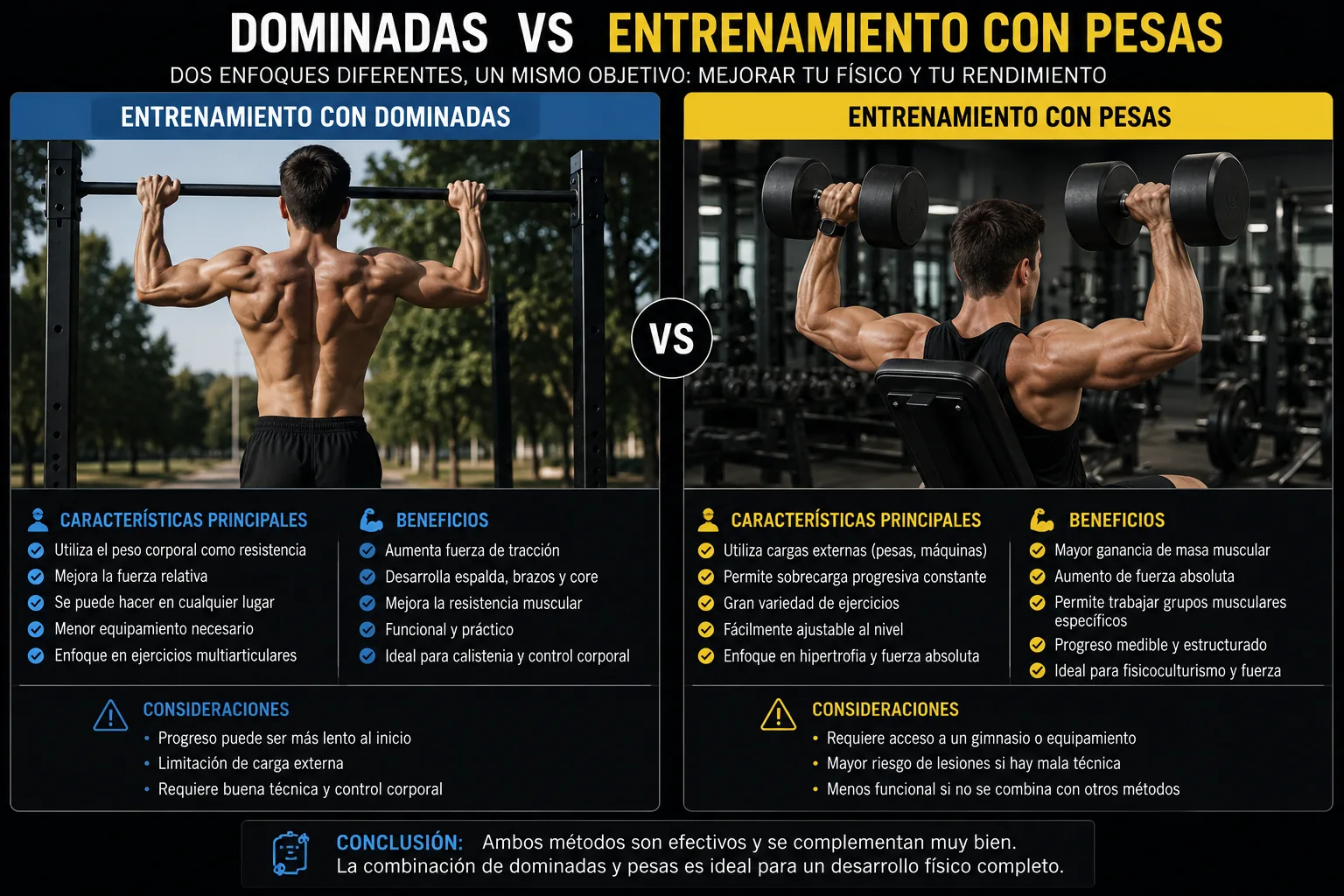
Which one builds more muscle?
This is probably the most important question.
The short answer is:
Both can build muscle mass.
However, the gym usually offers a slight advantage when the main goal is to maximize hypertrophy.
Because?
Because it is much easier to apply progressive overload.
You can gradually increase the weight in practically any exercise.
For example:
- Bench press.
- Squat.
- Biceps curl.
- Military press.
Such precise control makes it easy to continue stimulating muscle growth for many years.
In calisthenics it is also possible to progress, but in some exercises it is more difficult to adjust the difficulty with such precision.
Does calisthenics also gain muscle?
Of course.
Pull-ups, dips, and push-ups are great exercises to develop:
- Back.
- Chest.
- Shoulders.
- Arms.
Additionally, as you increase the difficulty of the variations, the muscle stimulation continues to grow.
Many calisthenics athletes have very developed physiques.
That shows that body weight can be enough to build a lot of muscle.
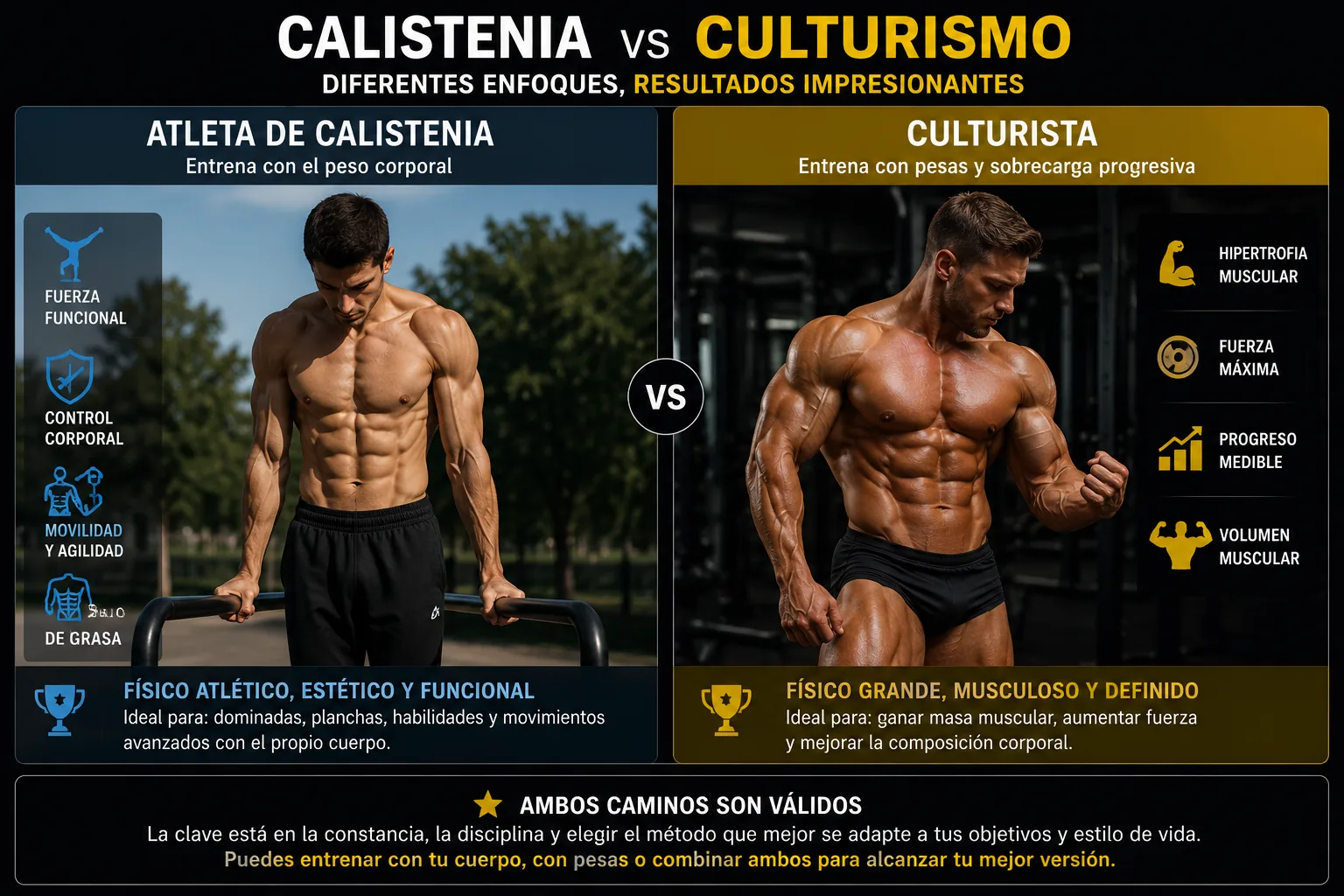
Which allows you to progress more easily?
Here the gym usually has the advantage.
Imagine that you do a bench press with 60 kg.
When that weight is no longer challenging, you can move on to:
- 62.5kg.
- 65 kg.
- 67.5kg.
The progression is very gradual.
On the other hand, in calisthenics many times the jump between one variant and another is considerable.
For example, going from a conventional push-up to a one-arm push-up makes a huge difference.
This makes the progression somewhat more complex.
What happens to the force?
It depends on the type of force.
The gym especially develops maximum strength against external resistance.
Calisthenics develops very specific strength related to body control.
For example:
- Maintain an iron.
- Perform a front lever.
- Complete a muscle up.
These skills require an enormous level of relative strength and coordination.
Therefore, both systems develop strength, although with different characteristics.

Which improves aesthetics more?
There is no absolute answer here.
Aesthetics mainly depend on:
- The muscle mass.
- The percentage of body fat.
- The genetics.
- The food.
Not the training kind.
It is perfectly possible to develop a very aesthetic physique whether by training in a park or in a gym.
However, those seeking to maximize muscle size often find more tools within weight training thanks to the enormous variety of exercises and the ease of isolating specific muscle groups.
After analyzing how calisthenics and weight training influence muscle development and strength, one important question remains: which should you choose? The answer depends on your objectives, the resources you have and, above all, the type of training you can maintain consistently. Both systems work, but each one excels in different aspects.
Advantages of calisthenics
Calisthenics offers numerous benefits that explain why millions of people practice it around the world.
Among its main advantages are:
- It hardly requires any material.
- It can be practiced outdoors.
- Improves body control.
- Develop coordination.
- Increases relative strength.
- Promotes mobility in many exercises.
- It is very economical.
In addition, learning skills such as the muscle up, planche or front lever is a very motivating challenge for many people.
Each new movement achieved represents a visible improvement in strength and technique.
Advantages of the gym
Weight training also has numerous strengths.
Among them stand out:
- Greater ease in applying progressive overload.
- Very wide variety of exercises.
- Possibility of isolating specific muscles.
- Very precise load adjustment.
- Greater ease in training legs with high loads.
- Excellent tool to gain muscle mass.
For those looking to maximize hypertrophy, the gym often offers more possibilities in the long term.

What happens to the legs?
One of the points where both methods tend to differ the most is the training of the lower body.
In calisthenics there are very effective exercises such as:
- One leg squat.
- Strides.
- Jumps.
- Nordic curl.
However, adding large loads is much more complicated.
In a gym you can easily progress through exercises such as:
- Squat.
- Dead weight.
- Press.
- Hip thrust.
- Bulgarian squat with dumbbells.
For this reason, many people consider that leg training is easier to do with weights.
And the injuries?
No method is completely injury-free.
It all depends on factors such as:
- Technique.
- Volume.
- Recovery.
- Progression.
- Load used.
In calisthenics, advanced skills can place a lot of stress on the wrists, shoulders, and elbows if practiced before you are ready.
In the gym, moving excessive weights or using poor technique also increases the risk of injury.
In both cases, proper progression is much more important than the chosen method.
Can they be combined?
In fact, it's probably one of the best options.
Many athletes combine:
- Pull-ups
- Funds.
- Push-ups.
With exercises like:
- Bench press.
- Squat.
- Dead weight.
- Barbell row.
This mix allows you to take advantage of the best of both worlds.
The relative strength and body control of calisthenics is improved while maintaining the ease of progressing with weight training loads.

Frequent errors
Thinking that one method is completely superior
The reality is that both work.
The important thing is how you train.
Choose only by fashion
Many people start a system because it is trendy on social networks.
The best choice is one that you really enjoy and can maintain for years.
Neglecting food
Neither the best calisthenics routine nor the best gym will compensate for an inadequate diet.
Nutrition continues to be one of the fundamental pillars to improve body composition.
not progress
The chosen method does not matter.
If you always do the exact same workout with the same difficulty, there will come a time when you will stop improving.
Progressive overload continues to be essential.
So what builds more physique?
If we talk exclusively about developing the greatest amount of muscle mass possible, the gym usually has a slight advantage thanks to the enormous ease of increasing the load and working each muscle group with precision.
However, this difference does not mean that calisthenics is inferior.
With a well-designed program it is also possible to build a strong, athletic and muscular physique.
Additionally, calisthenics develops skills, coordination, and body control that are often not worked on as intensely through traditional weight training.

Conclusion
The question shouldn't be whether calisthenics or the gym is better, but rather which one best fits your goals and lifestyle. Both methods allow you to develop strength, gain muscle mass and improve body composition when trained with intensity, good technique and adequate progression.
If your absolute priority is to maximize hypertrophy and gain muscle as efficiently as possible, the gym usually offers a slight advantage thanks to the ease of adjusting loads and working each muscle specifically. On the other hand, if you value the freedom to train anywhere, body control and learning complex skills, calisthenics can become an excellent choice.
In any case, it is not necessary to choose a single path. Many athletes combine exercises from both systems and achieve excellent results. In the end, the most effective training will always be the one that you enjoy, can maintain for years and allows you to progress steadily. The key is not in the place where you train, but in the quality of the work you do session after session.