When talking about training the abdomen, most people think of classic crunches, planks or leg raises. However, there is a small, inexpensive and surprisingly effective accessory that has gained enormous popularity among both beginners and high-level exercisers: the abdominal roller, also known as an ab wheel.
At first glance it seems like a very simple tool: a wheel with a bar and two grips. Precisely because of this simplicity, many people believe that it is a basic accessory or that it only serves to "mark the abs." The reality is very different. When used correctly, the abdominal roller is one of the most complete exercises to strengthen the core and improve stability of the entire body.
It's not just the abs that work. During each repetition, the obliques, lower back, shoulders, lats, glutes and even the arms also participate. In other words, the ab wheel forces the body to function as a single unit, something very useful both for improving sports performance and for increasing stability in strength exercises.
But is it really worth incorporating it into a routine? Is it better than irons? Is it used to gain abdominal strength or only for advanced people? To answer these questions you first have to understand how it works.
What is an abdominal roller?
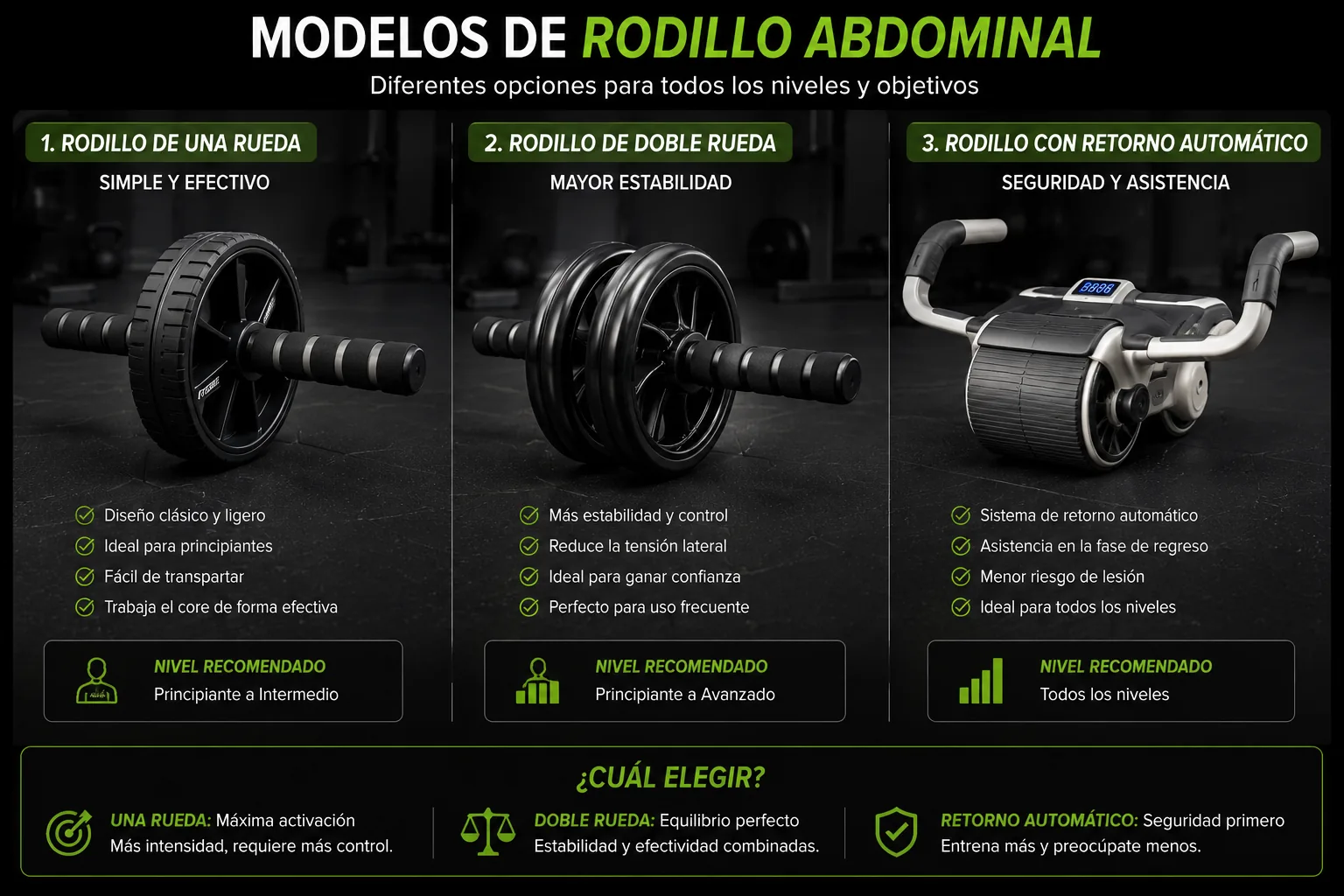
The ab wheel is an accessory made up of one or two wheels with a central axis and two side handles.
Its operation is very simple.
From an initial position, usually kneeling, the athlete rolls the wheel forward while keeping the trunk firm and controlling the entire movement.
Then return to the starting position using core strength.
Although the movement seems easy when performed by an experienced person, it requires great ability to maintain body stability throughout the entire movement.
That is precisely where its effectiveness lies.
What muscles does it work?
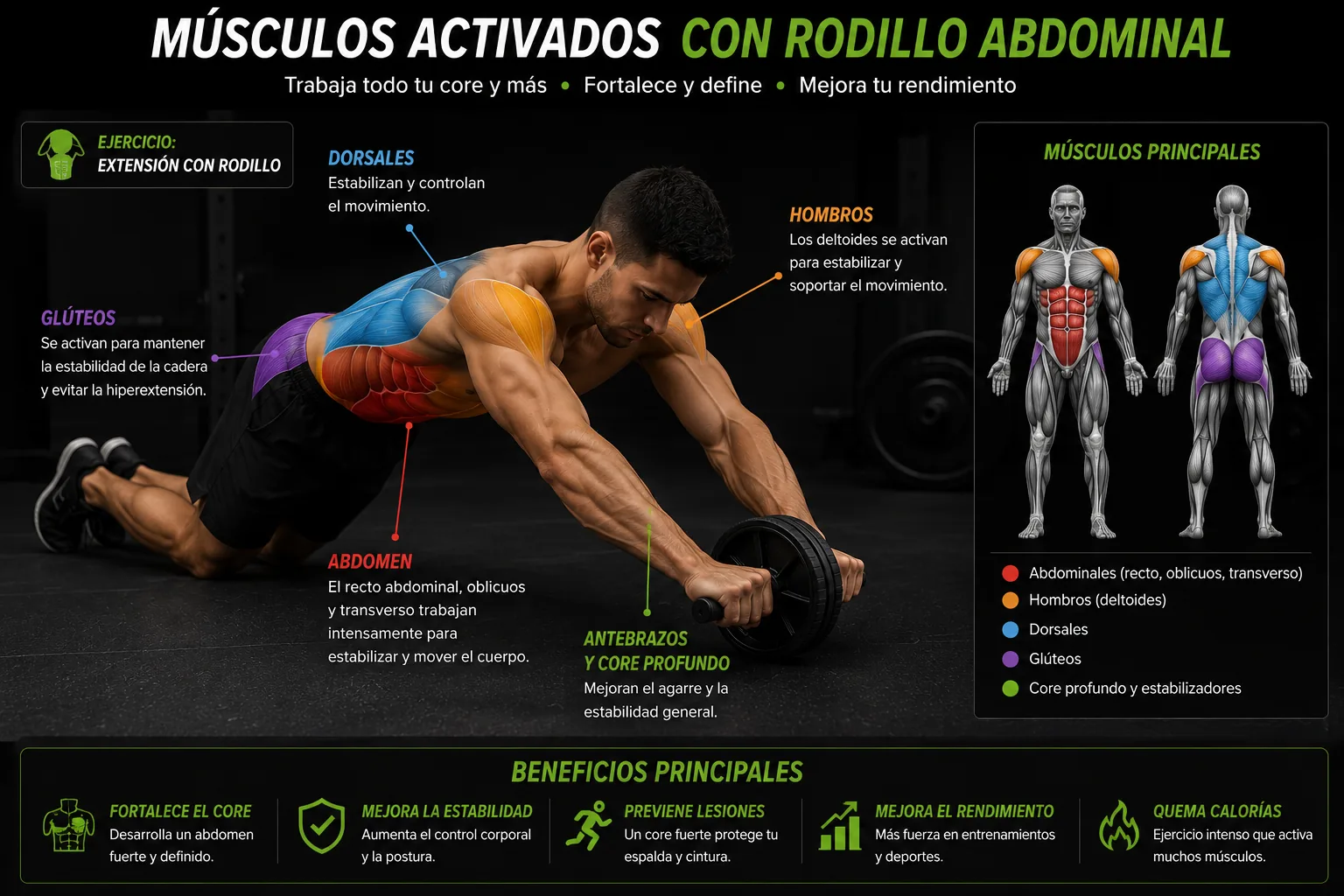
One of the biggest myths is to think that the roller only strengthens the abdomen.
In reality, numerous muscle groups participate.
Among them stand out:
- Rectus abdominis.
- Obliques.
- Transverse abdominis.
- Spinal erectors.
- Dorsals.
- Deltoid.
- Pectorals.
- Triceps.
- Glutes.
All of these muscles work together to prevent the back from arching as the body moves forward.
That is why the exercise is much more complete than it seems.
Much more than strong abs
The main objective of the ab wheel is not only to flex the trunk.
Its most important function is to resist movement.
During most of the exercise the abdominals work isometrically to prevent the lower back from sinking.
This type of work is called anti-extension.
And precisely this ability is very important to protect the spine during numerous sports movements and strength exercises.
Why is it so effective?
Because it forces the body to continually stabilize.
Unlike many traditional abdominal exercises, where you only flex the trunk, here you must control practically all the joints.
Every centimeter that the wheel advances increases the leverage arm and, therefore, the difficulty of the exercise.
This means that the tension on the core increases progressively during the ride.
That's why even a few repetitions can be very demanding.
Is it better than doing crunches?
Not necessarily.
They simply work the abdomen differently.
Crunches focus mainly on trunk flexion.
The abdominal roller, on the other hand, develops the core's ability to maintain stability and resist external forces.
Therefore, both exercises can coexist perfectly within a routine.
However, for many people the ab wheel offers greater transfer to other exercises such as:
- Squat.
- Dead weight.
- Military press.
- Pull-ups
All of them require a strong and stable core.
Benefits for sports performance
A strong core is not only useful for having visible abs.
It also helps:
- Improve the transmission of force between the lower and upper body.
- Increase body stability.
- Maintain better posture.
- Better control explosive movements.
- Reduce strength losses during complex exercises.
For this reason, the abdominal roller is part of the training of many athletes.

Does it work for all levels?
Yes, although with some adaptations.
People who are starting out can do the exercise:
- From the knees.
- With a short route.
- Perfectly controlling the technique.
As they gain strength they can progressively increase the distance traveled.
More advanced athletes even perform the rollout completely from the feet, a considerably more difficult variant that requires a very high level of strength and control.
The important thing is to progress little by little without losing the position of your back.
A small and very practical accessory
Another of its great advantages is that it barely takes up space.
Can be used:
- At home.
- In a gym.
- During a trip.
- In a park.
In addition, it usually has a very low price compared to other training accessories.
This makes it a very accessible tool for virtually anyone.
After knowing how the abdominal roller works and why it activates much more than the rectus abdominis, it is important to learn how to use it correctly. Although it seems like a simple accessory, poor execution can reduce its effectiveness and even increase stress on the lower back. The good news is that, with proper technique and gradual progression, the ab wheel can become one of the best exercises for developing a strong, stable and functional core.
How to correctly do a rollout with ab wheel
Technique is much more important than the distance you manage to cover.
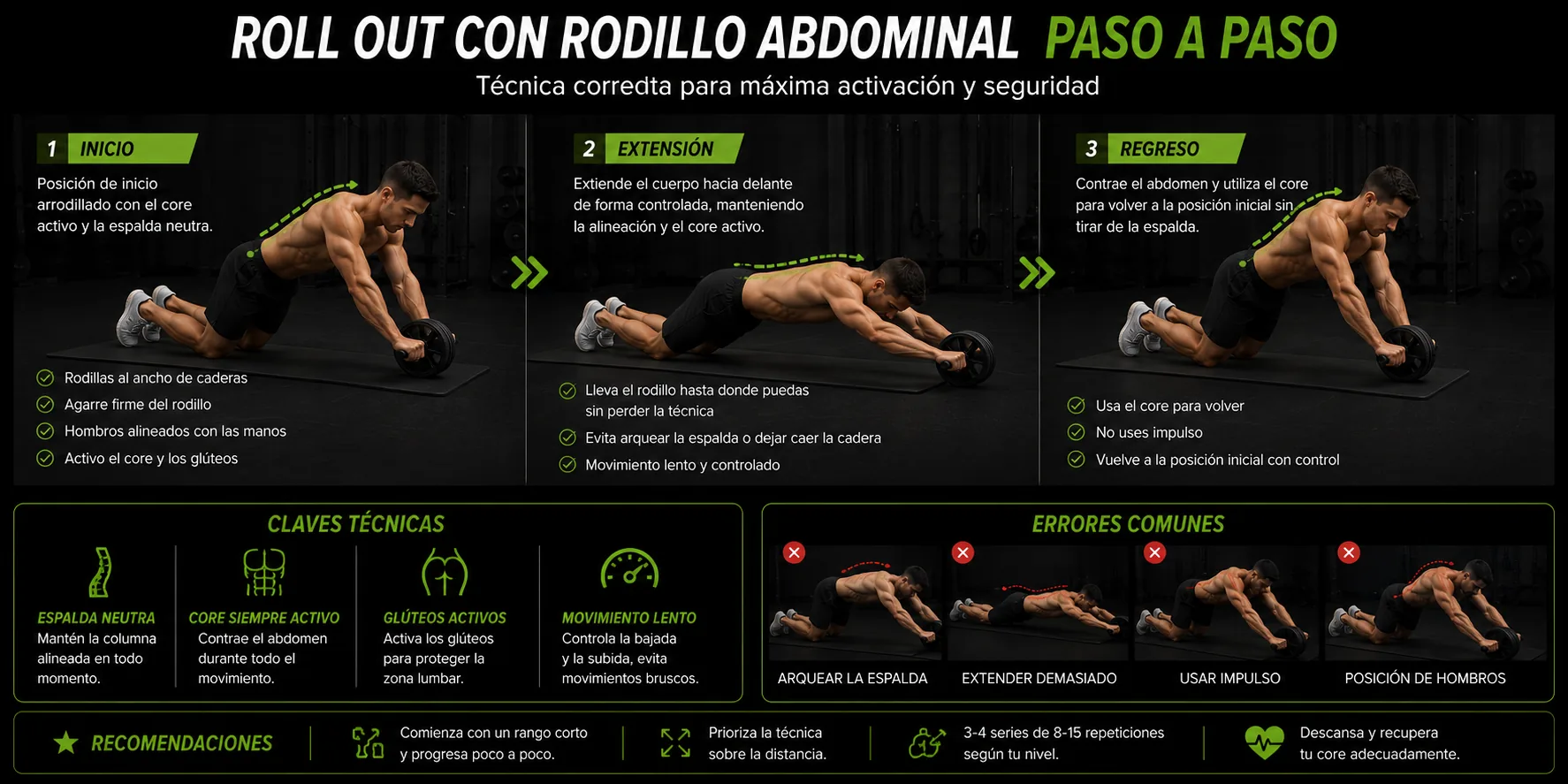
To perform a repetition correctly:
- Get on your knees on a comfortable surface, holding the roller with both hands.
- Activate your abdomen and glutes before starting the movement.
- Keep your back in a neutral position, avoiding arching your lower back.
- Slowly roll the wheel forward while keeping your body aligned.
- Move forward only to the point where you can retain control.
- Use the strength of your abdomen to return to the starting position without pushing yourself with your hips.
Throughout the entire journey your back must remain stable. The goal is not to go as far as possible, but to maintain core tension from start to finish.
Most frequent errors
Arch your back
It is the most common error and also the most important.
When the lower back sags, much of the tension stops falling on the abdomen and increases the stress on the spine.
If this happens, it is advisable to reduce the distance until you can maintain good posture.
Go too far
Many people try to go very far from day one.
However, the distance should increase as core strength improves.
It is preferable to perform shorter repetitions with good technique than to try excessive amplitude and lose control.
Use boost
The movement must be continuous and controlled.
Pushing off with the hips or returning quickly using inertia reduces the work on the abdomen.
Hold your breath throughout the series
Breathing correctly helps maintain stability.
The usual thing is to inhale before starting the movement and expel the air while returning to the starting position.
How to progress?
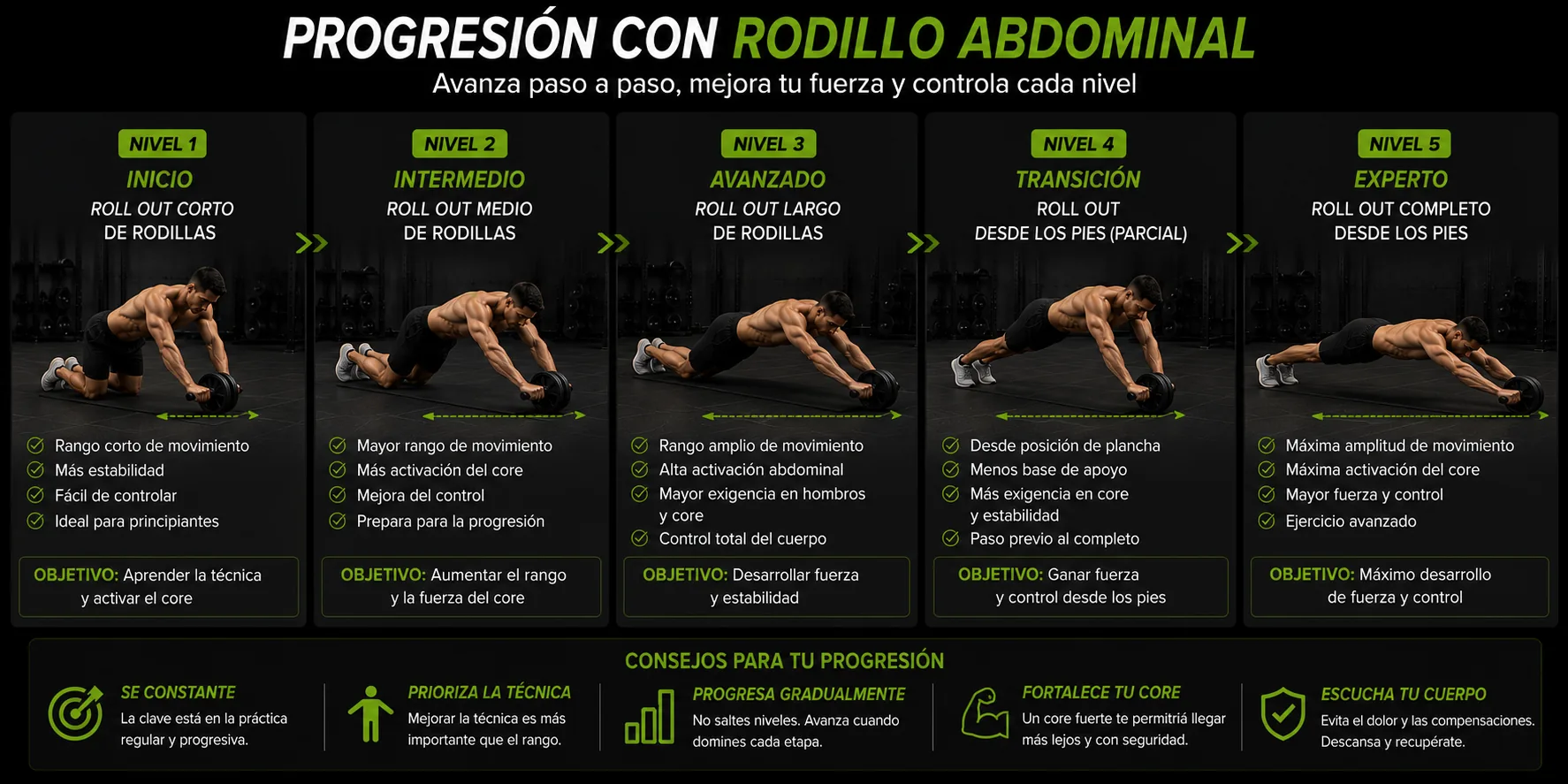
One of the biggest advantages of the abdominal roller is that it allows you to increase the difficulty little by little.
A simple progression could be:
- Very short rollouts from the knees.
- Progressively increase the distance.
- Reduce pauses between repetitions.
- Perform more repetitions with perfect technique.
- Move on to variations from the feet when there is enough strength.
There is no rush to reach the most advanced versions. Quality should always take priority over difficulty.
How often to use it?
For most people, it is enough to train with the abdominal roller two to three times a week.
It is not necessary to do it every day.
The abdomen also needs to recover, especially if you do exercises such as:
- Squats.
- Dead weight.
- Military press.
- Pull-ups
All of them already involve important core work.
Between two and four sets per session are usually enough to obtain good results.
Who can benefit most?
The abdominal roller is especially useful for:
- People who want to strengthen the core.
- Athletes who practice contact sports.
- Runners.
- Swimmers.
- Team sports players.
- Bodybuilding practitioners.
- Strength lifters.
In all of these cases, improving trunk stability can translate into better performance and greater efficiency during other movements.
Do you have any limitations?
Although it is a very effective accessory, it does not completely replace the rest of abdominal training.
The core has many different functions:
- Resist extension.
- Resist rotation.
- Resist lateral flexion.
- Transmit strength.
- Stabilize the spine.
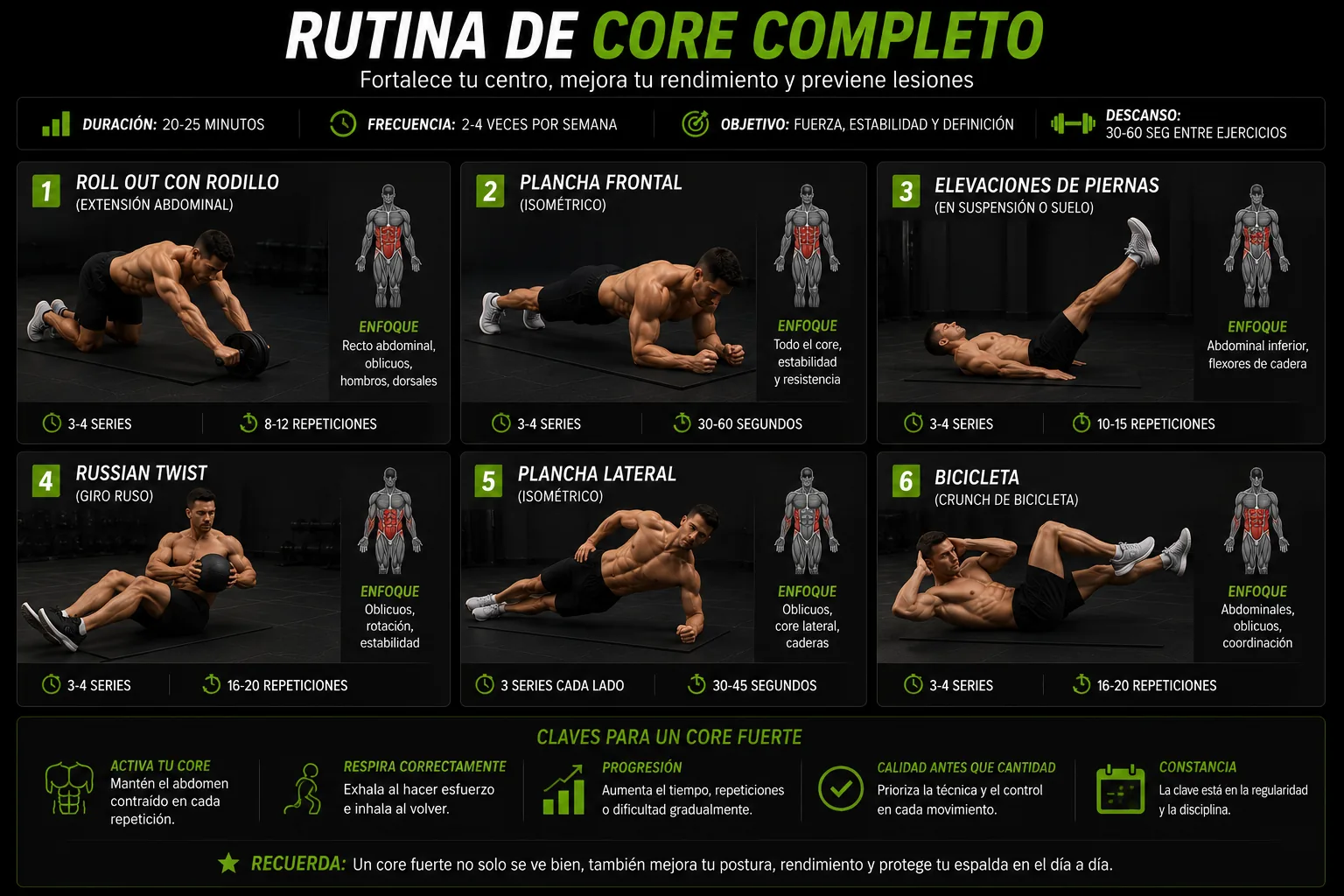
Therefore, it is advisable to combine the ab wheel with other exercises such as:
- Planks.
- Pallof press.
- Leg raises.
- Bird dog.
- Dead bug.
This way the training will be much more complete.
So is it worth using an abdominal roller?
Definitely.
Despite its size and low price, the ab wheel offers one of the most complete core workouts available.
It not only strengthens the abdomen, but improves the stability of the entire trunk, forces the coordination of numerous muscle groups and develops a very useful capacity for other strength exercises and for many sports disciplines.
Of course, as with any demanding exercise, the best results come when used with correct technique and adequate progression.
Conclusion
The abdominal roller proves that you don't need complex equipment to perform a highly effective workout. Thanks to its ability to challenge the core throughout the entire course, it has become one of the favorite accessories of both coaches and athletes of different levels.
Its main advantage is not only to strengthen the rectus abdominis, but also to teach the body to maintain stability while the arms and legs generate movement. This function is essential to improve performance in exercises such as the squat, deadlift, military press or pull-ups, in addition to being very useful in many sports.
If you start with proper progression, control your technique, and avoid arching your back, the ab wheel can help you develop a stronger, more functional abdomen than many traditional exercises. Combined with other core movements and a balanced training program, it is a simple, economical and extremely effective tool for improving long-term strength, stability and body control.