Training to muscle failure is one of the most discussed variables within strength and hypertrophy training. There are those who consider it essential to maximize muscle growth and those who avoid it completely to reduce fatigue. The reality is more nuanced: training to failure is neither mandatory nor harmful in itself, but rather a tool that can be very useful in specific contexts and problematic if used indiscriminately.
To understand it well, you must first define it precisely, understand what happens physiologically when failure is reached and differentiate between types of failure, because not all of them have the same implications.
What “training to failure” really means
Training to muscle failure means performing repetitions to the point where you cannot complete another additional repetition with correct form, even if you try your hardest.
But within this concept there are several levels:
1. Technical failure
It is the point at which you can no longer maintain correct execution. It is the most relevant in practical training, because it marks the safe limit in most exercises.
2. Concentric failure
It occurs when you cannot complete the rising phase of the movement, even though you can still partially move.
3. Absolute failure
It is when the muscle can no longer generate enough force to continue movement under any conditions.
In practice, absolute failure is rare in well-structured training. The usual thing is to work close to the technical failure or reach it in specific series.

What happens in the muscle when you train to failure
When you approach or reach failure, the body goes through several simultaneous changes:
- All available motor units are progressively recruited
- Increases metabolic stress in the muscle
- The accumulation of metabolites (lactate, ions, etc.) increases.
- High peripheral and central fatigue occurs
From the stimulus point of view, this can be positive because it ensures very high muscle activation. However, this level of activation comes at a significant cost: accumulated fatigue.
Benefits of training to failure
1. Maximum recruitment of muscle fibers
Training close to failure ensures that even high-threshold fibers are activated, especially in moderate or high rep ranges.
2. Greater stimulus per series in certain contexts
In isolation exercises or with moderate loads, reaching failure can increase the effectiveness of each set without needing to increase the weight.
3. Efficiency in low volume routines
When the total weekly volume is low, the failure can partially compensate for the lower number of sets.
4. Real effort learning
It allows you to develop a better perception of effort and the real limit of performance.

Cost of training to failure: the critical part
The problem with failure is not its immediate effectiveness, but its cumulative impact on recovery and future performance.
1. High peripheral fatigue
The muscle fatigues much faster, which reduces performance capacity in subsequent sets of the same workout.
2. Systemic fatigue
Not only the worked muscle is fatigued, but also the central nervous system, affecting overall performance.
3. Reduction of effective volume
Although a set to failure is intense, it can reduce the quality of subsequent sets, lowering the total useful volume.
4. Interference with load progression
If you always train to failure:
- You find it difficult to gain weight
- Recovery becomes slower
- Long-term progression stalls
5. Technical risk in compound exercises
In complex movements such as:
- Squat
- bench press
- Dead weight
Failure can compromise technique, increasing the risk of poor performance and reducing stimulus efficiency.
When failure is most useful
Although it has costs, failure is not negative in itself. Its usefulness depends on the context:
1. Isolation exercises
In movements such as curls, extensions or lateral raises, the technical risk is low, so failure can be safer and more efficient.
2. Last series of an exercise
Using it occasionally at the end of an exercise can maximize stimulus without compromising the entire session.
3. Low volume phases
When you do fewer sets per week, getting closer to failure can partially compensate for the lesser amount of work.

Part 1 Key Idea
Training to failure is not a universal rule, but rather a high-intensity tool with a high cost in terms of fatigue. Its value depends on the balance between stimulus and recovery, and not on its constant use.
Train to failure yes or no?
In the first part we saw what training to failure really means, what happens inside the muscle and why it can be useful in certain contexts, especially in isolation exercises or in low volume phases. Now it's time for the decisive part: when NOT to use it, how to structure it correctly and what is the most efficient strategy to progress without accumulating unnecessary fatigue.
When you should NOT train to failure
The most common mistake is not to use the ruling, but to abuse it in situations where the cost clearly outweighs the benefit.
1. Heavy compound exercises
In movements like:
- Squat
- bench press
- Dead weight
- Barbell row
failure is usually a bad idea for several reasons:
- The technique degrades quickly
- Increases risk of injury or poor performance
- Systemic fatigue is very high
- Reduces performance in the rest of the training
In these exercises, the stimulus is already high enough without the need to reach failure.
2. Programs with high weekly volume
If you are already doing many sets per muscle per week:
- Constantly adding failure can be excessive
- Recovery becomes the limiting factor
- Progress can stall due to accumulated fatigue
In these cases, the problem is not a lack of intensity, but rather total excess stress.
3. Maximum strength phases
When the main objective is strength:
- It is best to work with 1–3 repetitions in chamber (RIR)
- Maintain perfect technique under high loads
- Avoid extreme fatigue
Failure here interferes with the quality of the lift.
How to use glitch intelligently
The optimal approach is not “all or nothing,” but strategic.
1. Exercise type rule
- Isolation → most frequently allowed failure
- Compounds → avoided or very specific failure
2. Series rule
- First sets → close to failure (RIR 1–3)
- Latest series → occasional failure
This allows quality to be maintained while stimulus is maximized.
3. Volume rule
The greater the total volume:
- Failure is less necessary
- Recovery is more important
- More relevant is consistency

Weekly optimal strategy
An efficient structure for most people would be:
Compound exercises
- 0% to 10% sets to failure
- Work mostly in RIR 1–3
Accessory exercises
- 10% to 30% of sets to failure
- Moderate use in recent series
Isolations
- 30% to 60% sets to failure
- More frequent use, especially at the end
This distribution allows stimulus to be maximized without compromising the global recovery.
Signs that you are abusing the bug
If you train too much to failure, clear symptoms appear:
- Constant fatigue during the week
- Progressive performance drop
- Excessive and prolonged muscle pain
- Stagnation in loads
- Feeling of “always going to the limit”
This indicates that the system is accumulating too much fatigue for the stimulus it receives.
Signs that you are using it well
- You progress in loads in a stable way
- You recover between sessions
- You maintain good technique in most exercises
- No chronic fatigue
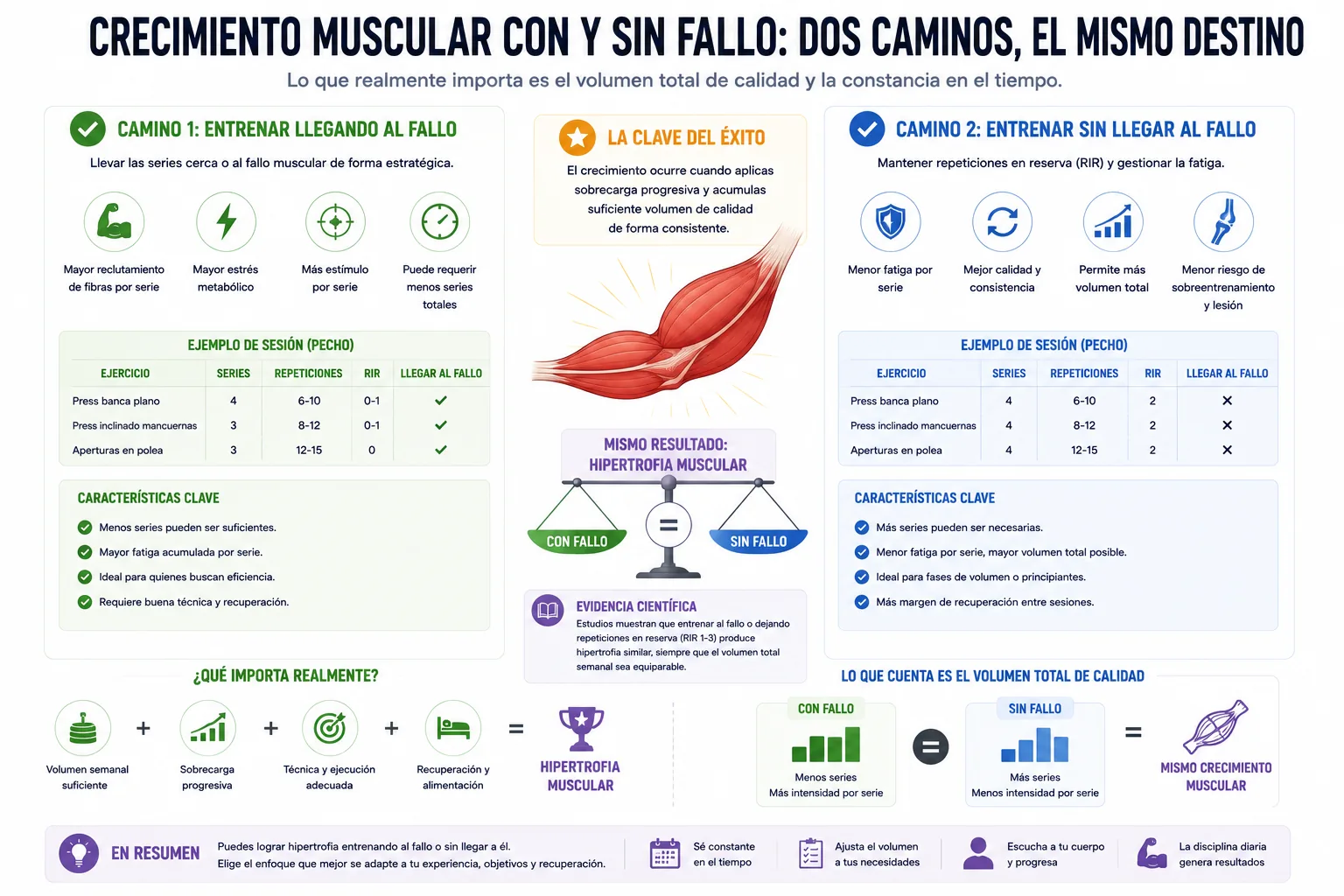
Key idea: failure is not necessary to grow
An important point that often surprises:
You don't need to train to failure to gain muscle.
Hypertrophy also occurs when working close to failure, provided there is:
- Progressive overload
- Sufficient volume
- Consistency
- Proper recovery
Failure may increase the stimulus per set, but is not a mandatory requirement.
Conclusion
Training to failure is neither good nor bad in itself. It is an advanced tool that can enhance stimulation in certain contexts, but can also limit progress if used uncontrollably.
The most efficient strategy is clear:
- Compounds → avoid failure or use it very occasionally
- Isolations → use it strategically
- High volume → reduce fault
- Low volume → may be more useful
Real progress does not depend on always pushing the limit, but on balancing stimulus and recovery intelligently and sustainably.