Anyone who has started training or has done a particularly intense session knows perfectly well the feeling of waking up the next day with muscle soreness. Walking is harder, sitting seems like a challenge, and movements you normally do without thinking become uncomfortable. We know this muscle pain that appears hours after exercise as soreness, and there are numerous myths surrounding them. Some people think that they indicate that the training has been excellent, while other people believe that training with laces can be dangerous and cause injuries.
So, is it good to train with tightness or should you wait for them to disappear completely before returning to the gym?
The answer is not a simple yes or no. It mainly depends on the intensity of the soreness, the affected muscle group, the type of training you are going to do and your recovery capacity. In most cases, training with mild or moderate soreness is not only safe, but can even help reduce feelings of stiffness. However, when the pain is very intense or clearly limits movement, the smartest thing is usually to modify the session or allow more recovery time.
To understand when you can train and when it is better to rest, you first have to understand what soreness really is and why it appears.
What really are shoelaces?
Soreness is scientifically called delayed onset muscle soreness, known internationally as DOMS (Delayed Onset Muscle Soreness).
Unlike a muscle injury, soreness does not appear immediately after training. Typically, they begin between 8 and 24 hours after exercise, reach their peak between 24 and 72 hours, and gradually disappear over the following days.
For a long time it was believed that soreness appeared due to the accumulation of lactic acid in the muscles. Today we know that this theory is false. Lactic acid is eliminated within a few hours after exercise and does not remain in the muscle for days.
What really happens is much more complex.
When you train, especially if you do new exercises, increase the intensity a lot, or work with a large eccentric load (the phase in which the muscle lengthens while supporting weight), small microscopic alterations occur in the muscle fibers and the connective tissue that surrounds them.
These microlesions trigger a controlled inflammatory response. The body sends immune system cells to initiate tissue repair, increases blood flow to the area and begins the adaptation process. This temporary inflammation is responsible for the sensitivity, stiffness and pain characteristic of soreness.
It is important to note that these micro-injuries are part of the normal process of adaptation to training and do not mean that the muscle is injured.

Do soreness mean that you have trained well?
This is probably the most widespread myth in the world of fitness.
Many people believe that if they don't feel sore the next day it means that the training has been of no use. Actually, this is not true.
You can have an excellent session and have practically no soreness.
You can also end up with very intense muscle soreness after an ineffective workout.
Soreness mainly indicates that the body has received a stimulus to which it was not completely adapted. This usually occurs when:
- You start training after a long period of inactivity.
- You change several exercises in your routine.
- You greatly increase your training volume.
- You considerably increase the intensity.
- You introduce movements with a large eccentric component.
As your body adapts, soreness usually decreases even if you continue to make progress.
This is known as the repeated session effect. The muscle learns to respond better to the same stimulus and muscle damage decreases without implying a reduction in growth or strength gains.
Therefore, pursuing soreness as the goal of each workout does not make sense.
The true indicator of progress is to improve little by little in aspects such as:
- The force.
- The technique.
- The training volume.
- The resistance.
- Body composition.
Soreness is simply a possible consequence of training, not proof that it was good.
What happens if you train with shoelaces?
This is where most of the doubts appear.
If the soreness is mild or moderate, training is usually perfectly safe.
In fact, starting the session with a proper warm-up increases blood flow to the muscle and many people notice that the pain decreases considerably once they start moving.
This occurs because muscle temperature increases, mobility improves and the feeling of stiffness is temporarily reduced.
However, this doesn't mean you should ignore any pain.
If the pain is so intense that:
- They clearly limit the range of motion.
- They alter your technique.
- They prevent you from performing the exercise correctly.
- They affect your balance or coordination.
The most advisable thing is to modify the session.
In those cases you can train other muscle groups or do an active recovery session instead of insisting on the sore muscle.

Does training with tights affect muscle growth?
This is another of the most frequently asked questions.
In general, mild soreness does not significantly reduce hypertrophy or strength gains.
The problem appears when the pain is so intense that performance decreases.
For example:
- You lift much less weight.
- You do fewer repetitions.
- Your technique gets worse.
- You cannot complete the planned volume.
In these circumstances the training stimulus will be less and it will probably be more profitable to wait an additional day to fully recover.
Therefore, the decision should not be based solely on whether you are sore or not, but on whether you are capable of training with quality.
Once you understand what soreness really is and why it occurs, it becomes much easier to decide whether you should train or not. The key is not to avoid any discomfort, but to differentiate between normal muscle soreness caused by training and an injury that requires rest and attention.
Many people stop training as soon as they feel a little soreness, while others do just the opposite and force very intense sessions even though they can barely move the affected muscle. Neither of these extremes is usually the best option. The most advisable thing is to learn to interpret the body's signals and adapt the training depending on how you feel that day.
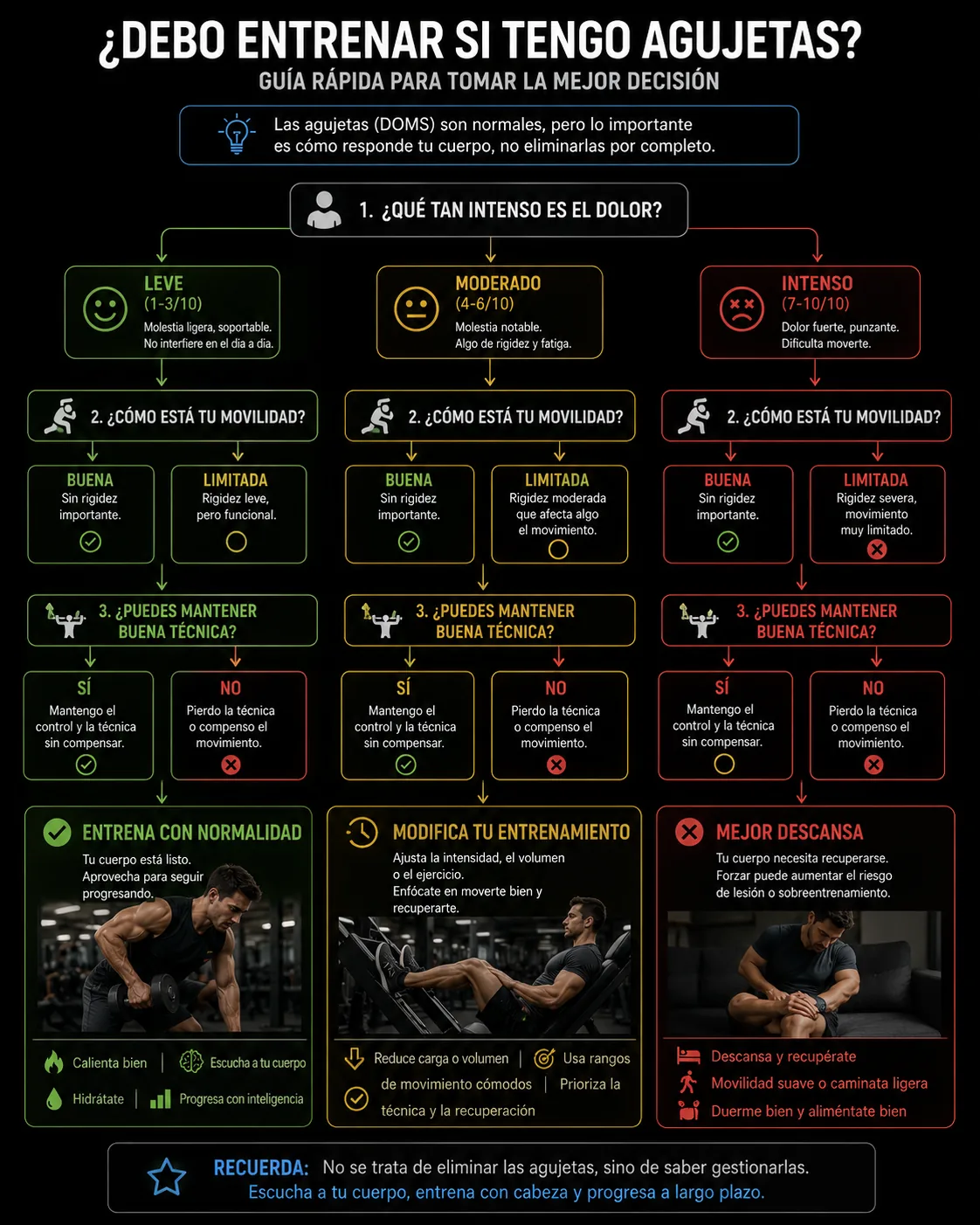
How to know if you can train with shoelaces
There is a very simple rule that many coaches use.
Do a good warm-up for 10 to 15 minutes and evaluate how the muscle responds.
If after heating:
- The pain clearly decreases.
- You regain almost all mobility.
- You can perform the exercises with good technique.
- Performance hardly changes.
You can probably train without a problem.
However, if after warming up:
- The pain is still very intense.
- You cannot perform the full movement.
- The technique gets worse from the first repetitions.
- You notice a significant loss of strength.
The smartest thing is to modify the session.
Listening to these signals usually avoids problems and allows you to maintain good continuity in training without compromising recovery.
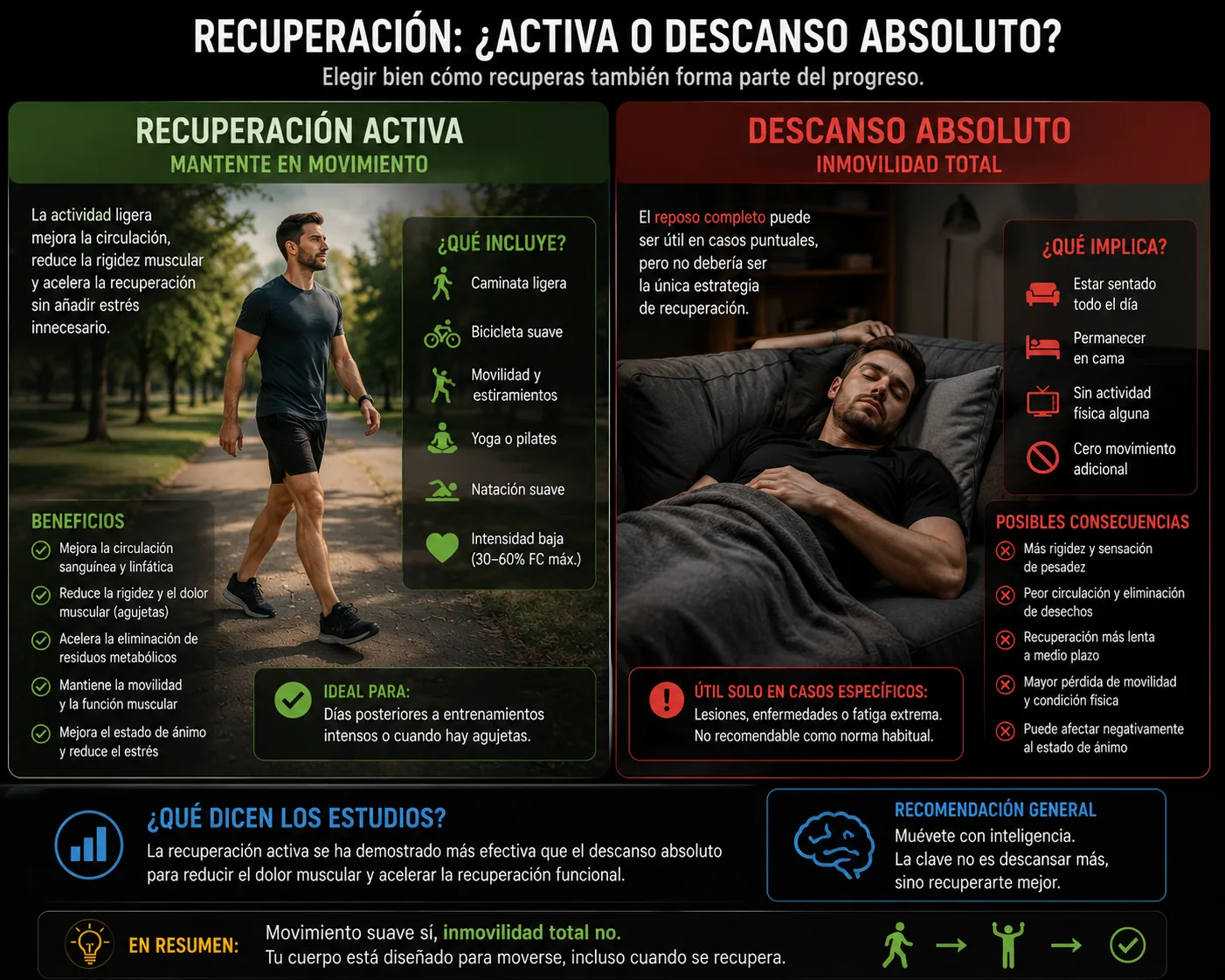
Is it better to rest completely?
Not always.
In fact, when the soreness is mild or moderate, remaining completely inactive usually makes the stiffness last longer.
On the contrary, gentle movement can promote recovery.
This is what is known as active recovery.
Some useful options are:
- Walk.
- Pedal at low intensity.
- Swim gently.
- Perform mobility exercises.
- Do a light session with little weight.
These activities increase blood flow, help maintain mobility, and reduce feelings of stiffness without adding excessive strain to the muscle.
Of course, active recovery does not mean doing another intense workout. The objective is to promote circulation and facilitate the natural repair process.
What exercises produce the most soreness?
Not all workouts generate the same level of muscle soreness.
The pain tends to be more intense when several factors are combined:
- New exercises.
- Lots of training volume.
- High intensity.
- Great eccentric component.
- Long range of motion.
For example, it is common to experience significant soreness after exercises such as:
- Bulgarian squat.
- Romanian deadlift.
- Walking strides.
- Pull-ups controlling the descent a lot.
- Femoral curl with emphasis on the eccentric phase.
This does not mean that these exercises are bad. On the contrary, they tend to be very effective, but they also require greater adaptation of the muscle.

How to reduce soreness
Although there is no way to eliminate them completely, there are strategies that can reduce their intensity or speed up recovery.
1. Progress gradually
It is the most effective measure.
Avoid increasing suddenly:
- The weight.
- The number of series.
- The repetitions.
- The weekly frequency.
A gradual progression allows the muscle to adapt without causing excessive damage.
2. Get enough sleep
Much of muscle recovery occurs during sleep.
Sleeping between seven and nine hours promotes the repair of muscle fibers and reduces the time needed to recover.
3. Eat enough protein
Proteins provide the amino acids necessary to rebuild muscle tissue after training.
They do not eliminate soreness, but they do promote a more efficient recovery.
4. Maintain good hydration
Adequate hydration helps the correct functioning of all physiological processes related to recovery.
5. Don't skip warming up
Although warming up does not completely prevent soreness, it does prepare the muscle for effort and can reduce the risk of excessive discomfort.
Is it advisable to stretch when you have soreness?
It is another very common question.
Gentle stretches may temporarily relieve feelings of stiffness, but they do not eliminate soreness or significantly speed recovery.
On the other hand, performing very intense stretches on a very sore muscle can be uncomfortable and even increase the discomfort.
It is best to prioritize mobility and gentle movements over aggressive stretching.
Soreness or injury: learn to differentiate them
One of the most important aspects is knowing when pain is no longer normal.
Shoelaces usually have these characteristics:
- They appear several hours after training.
- They are diffuse.
- They affect the entire muscle.
- They progressively improve with the days.
- They decrease when warming.
Instead, an injury usually presents:
- Sharp or stabbing pain.
- Immediate appearance during exercise.
- Localized inflammation.
- Hematoma in some cases.
- It gets worse when you try to move the muscle.
If you suspect that you may have been injured, it is advisable to stop training and consult a health professional.
The mistake of chasing shoelaces
Many people believe that if a workout doesn't cause soreness, it means it hasn't worked.
This leads to constantly changing exercises, increasing volume unnecessarily or training much more than is really necessary.
The reality is that the body adapts.
The more you train, the less soreness you will have with the same stimulus.
And that doesn't mean you're stopping progressing.
In fact, many very advanced athletes barely experience soreness for much of the season because their body is already perfectly adapted to their routine.
Progress is measured by:
- More strength.
- Best technique.
- Greater muscle mass.
- Better performance.
- More work capacity.
Not because of the pain you feel the next day.
Conclusion
So, is it good to train with shoelaces?
In most cases, yes, as long as they are mild or moderate and do not affect the quality of movement. A proper warm-up, good technique and the ability to adapt the intensity of the training allow you to continue progressing without having to wait for any discomfort to disappear.
On the contrary, when the soreness is so intense that it limits your mobility, greatly reduces your strength or alters the execution of the exercises, the smartest thing is to prioritize recovery or train other muscle groups.
Shoelaces are not an enemy, but neither are they an objective. They are part of the normal process of adaptation to training, especially when you introduce new stimuli or increase the workload. As the weeks go by, they will decrease as your body becomes more efficient, and that is a sign of adaptation, not lack of progress.
In the end, the best strategy is not to avoid soreness at all costs or to look for them in every workout, but to find the balance between sufficient stimulus to progress and adequate recovery that allows you to continue training constantly. Because, as with almost everything in fitness, the best results do not come from an isolated session, but from the sum of hundreds of well-planned workouts.