Rest between sets is a key variable in strength and hypertrophy training that is often underestimated. Most people adjust the weight or repetitions, but leave rest “to chance”, when in reality it directly influences performance, total volume and, consequently, muscular adaptations.
There is no single universal time valid for all cases. Optimal rest depends on the objective (strength, hypertrophy or endurance), the type of exercise, the intensity of the load and the level of accumulated fatigue.
What really happens in the body between sets
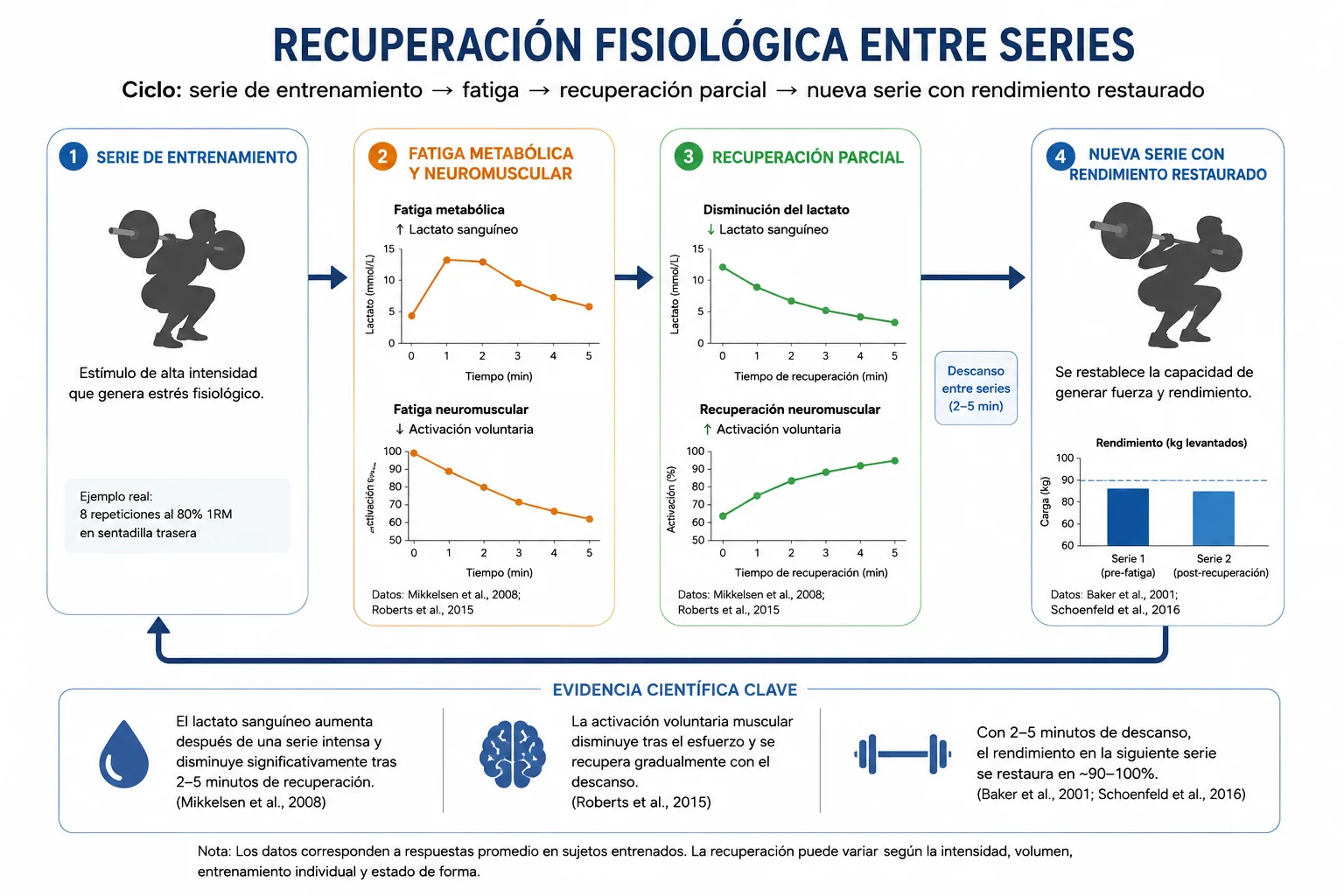
When you finish a series, you don't just “rest.” You are recovering different physiological systems:
- Energy system (ATP-PC): responsible for explosive and short efforts
- Glycolytic system: involved in intense efforts of medium duration
- Neuromuscular system: ability of the nervous system to recruit muscle fibers
- Accumulated metabolites: such as lactate, hydrogen ions and other fatigue byproducts
Rest between sets allows these systems to partially recover in order to repeat the effort with the highest quality possible.
If rest is insufficient, the body does not return to its optimal state and performance progressively drops.
Rest according to the training objective
The rest time changes depending on what you are looking to adapt:
1. Maximum strength
- Rest: 2 to 5 minutes
In strength training (1–5 repetitions with high loads), the goal is to maximize the ability to produce force in each set.
You need to recover:
- Phosphocreatine (immediate energy)
- Neuromuscular capacity
- Technique under high load
If you rest little in this context:
- Lower effective load
- Technique deteriorates
- Decreases performance in subsequent series
2. Hypertrophy (muscle gain)
- Rest: 1 to 3 minutes
This is the most used range in aesthetic-oriented gym training.
The goal here is not just to lift heavy, but to accumulate:
- Training volume
- Sufficient mechanical tension
- Controlled metabolic stress
Too short a rest can limit the load you use, reducing your overall stimulus. Too long a rest can decrease the density of the training without providing clear additional benefits.
3. Muscle resistance
- Rest: 30 to 60 seconds
In this case, fatigue tolerance is sought rather than maximum performance. Metabolic stress is high and short rest is part of the stimulus.

Why rest influences muscle growth so much
Muscle growth depends on three main factors:
- mechanical stress
- Effective volume
- Load progression
The rest between sets directly affects all three.
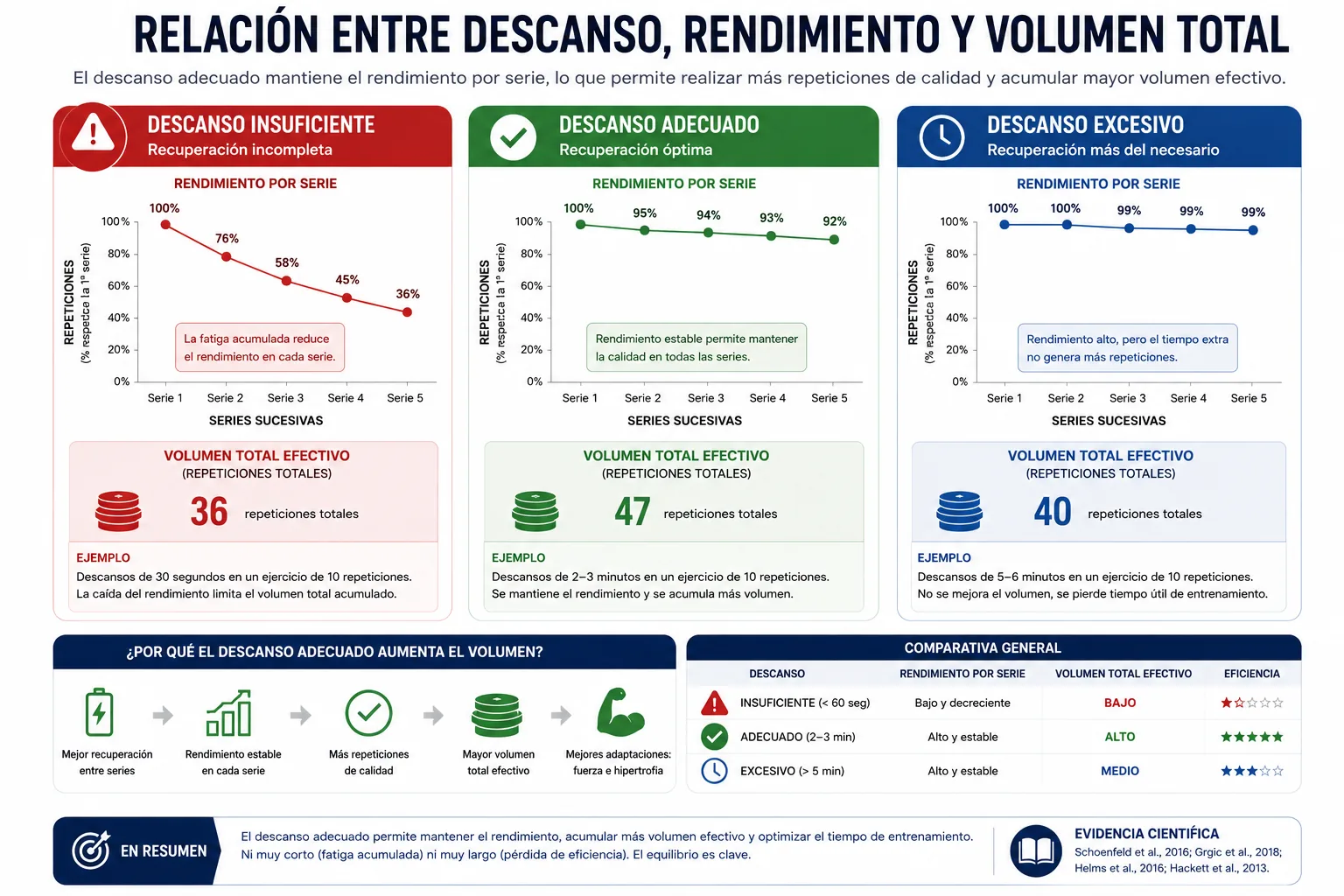
If you rest too little:
- You can't keep the weight off
- You lose effective reps
- You reduce the total volume of quality
If you rest adequately:
- You keep the intensity
- You accumulate more useful work
- You improve the overall stimulus

Factors that modify the ideal rest
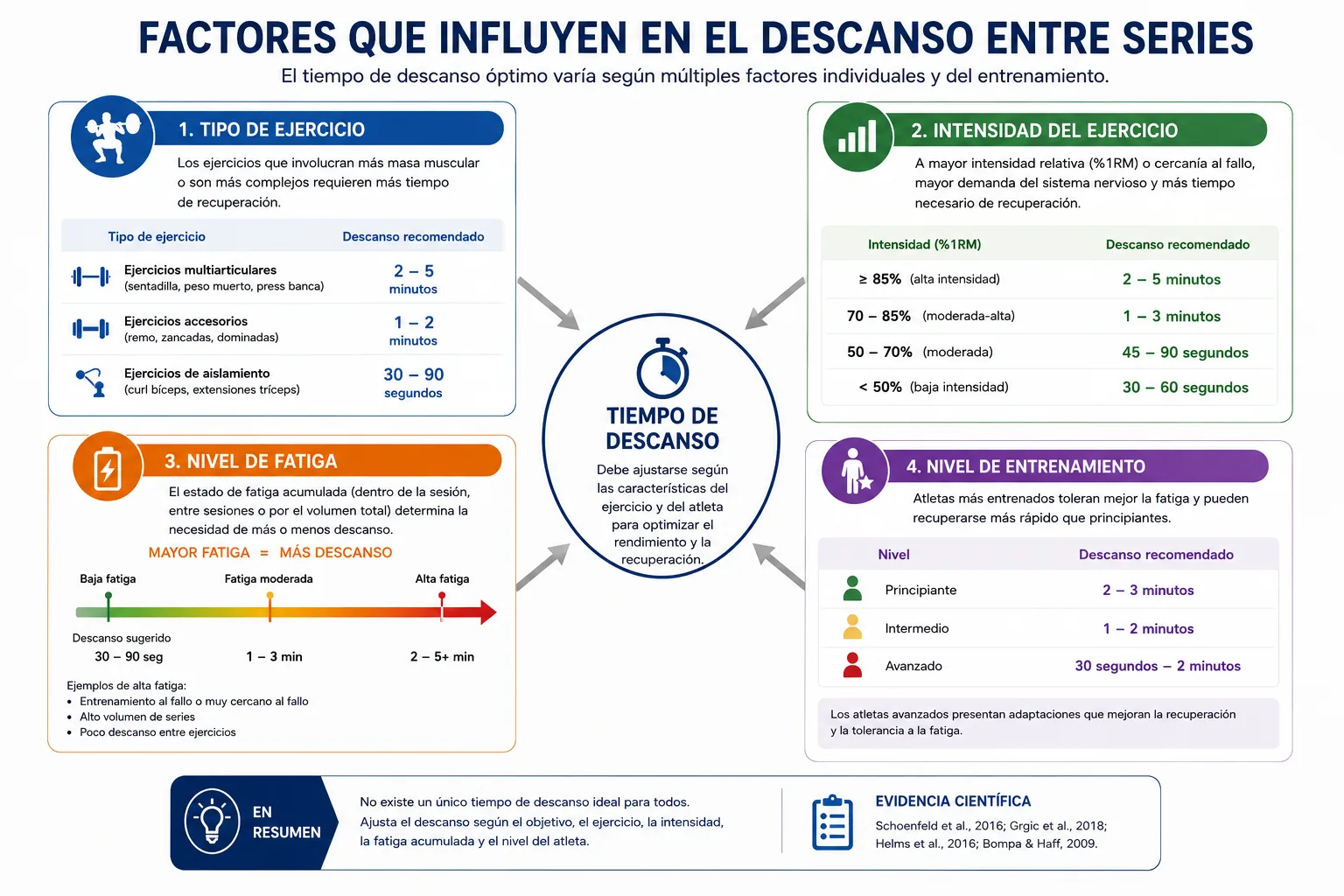
Although the ranges above are useful, the actual rest should be adjusted based on:
1. Type of exercise
- Compounds (squat, bench press, deadlift): require more rest
- Isolations (biceps curls, lateral raises): require less rest
2. Load intensity
- High loads → more rest
- Moderate loads → medium rest
- Light loads → short rest
3. Training level
More trained people usually need more rest to maintain maximum performance, since they use higher loads and generate more neuromuscular fatigue.
4. Accumulated fatigue
The break also depends on the context:
- Dream
- Stress
- Previous training volume
- Feeding
Common mistake: always using the same break
One of the most frequent mistakes is applying a fixed time:
- “I always rest 60 seconds”
- “I always rest for 2 minutes”
This is inefficient because each exercise and goal requires a different recovery. A rigid system limits performance and reduces the ability to progress.
First partial summary
The rest between sets is not a secondary detail, but a variable that determines how much quality work you can accumulate in a session.
In general terms:
- Strength → long breaks
- Hypertrophy → medium rests
- Endurance → short breaks
But the fine adjustment depends on the exercise, load and actual fatigue.
In the first part we define the rest ranges according to objective, the basic physiology behind recovery and why rest directly affects performance. Now let's get to the most important thing: how to apply it in a real routine, how to adjust rest depending on the exercise and what mistakes are slowing down your progress without you realizing it.
How to apply rest into a real routine
In real training there is no single fixed rest time. Rest should change within the same session depending on the type of exercise.
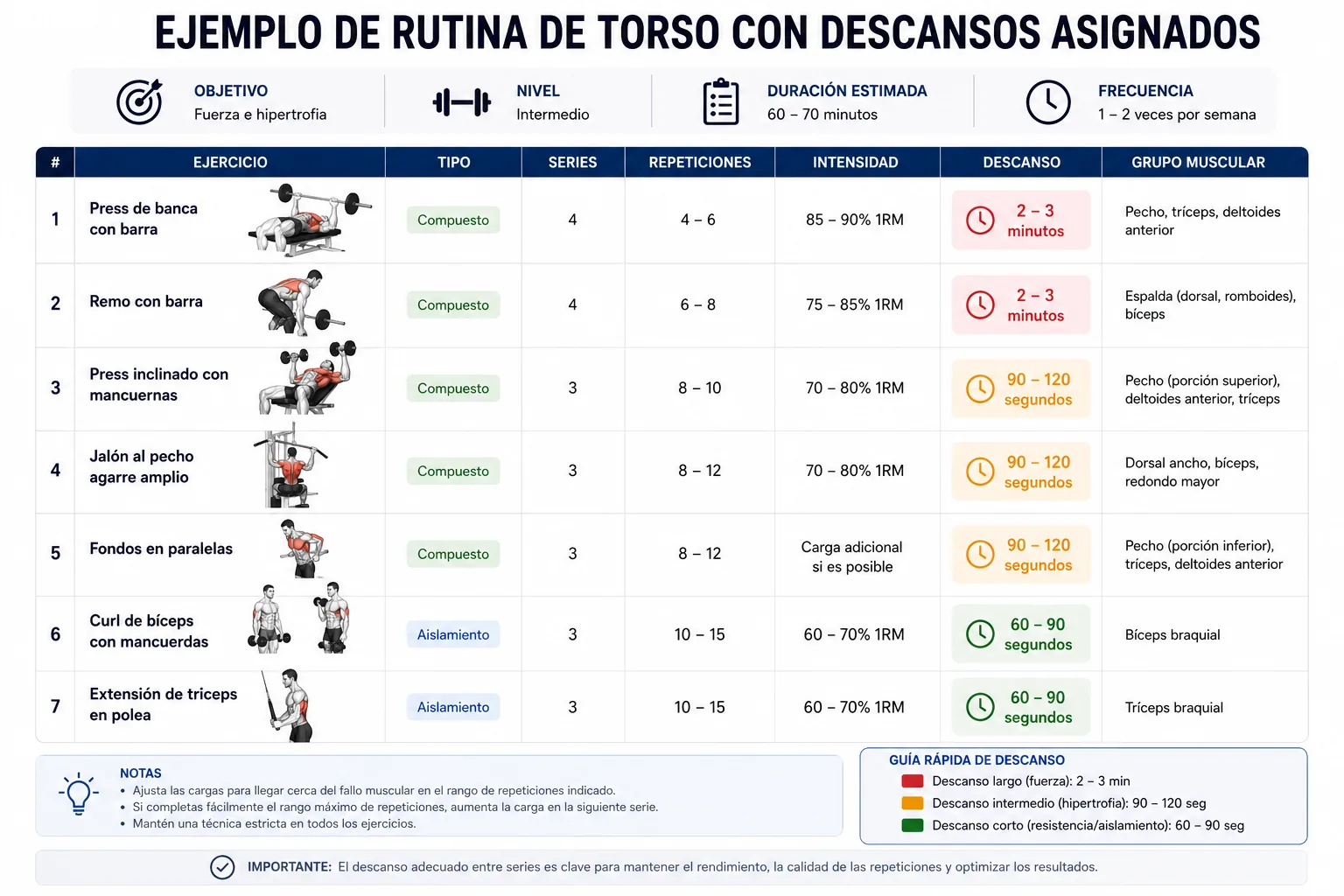
Example in a torso routine:
- Bench press: 2–4 minutes
- Weighted pull-ups: 2–3 minutes
- Military press: 2–3 minutes
- Barbell row: 2–3 minutes
- Lateral raises: 60–90 seconds
- Biceps curl: 60–90 seconds
- Triceps extension: 60–90 seconds
This shows something key: large exercises require more rest than isolation exercises.
Why compound exercises need more rest
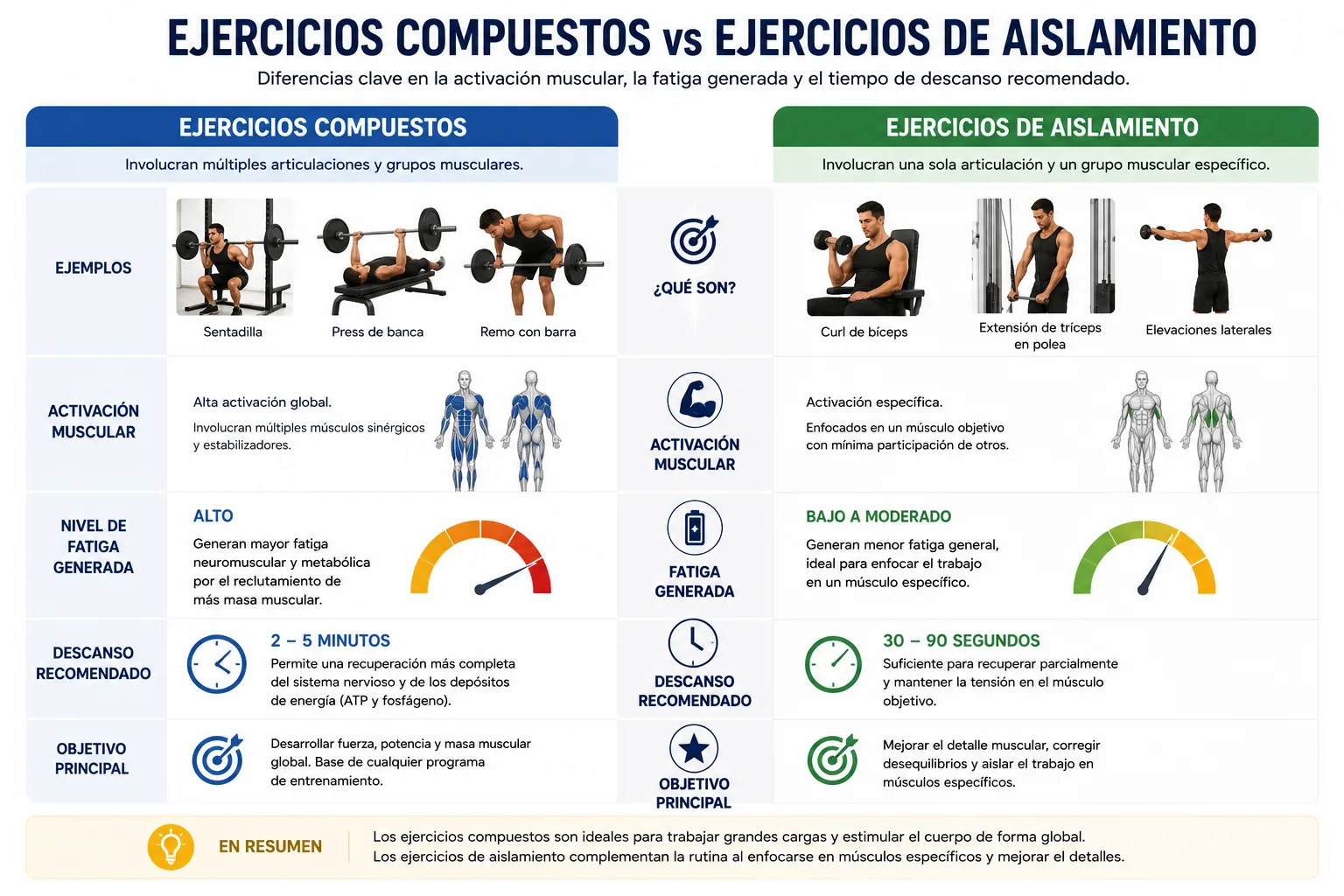
Multi-joint exercises (squat, bench press, deadlift, pull-ups) involve:
- Greater muscle mass involved
- Increased demand on the central nervous system
- Higher power consumption per series
- More accumulated systemic fatigue
That is why they need more time to recover performance.
If you don't get enough rest in these exercises:
- You lose strength with each series
- The technique is degraded
- You reduce the total effective volume
- Increases risk of fatigue injury
Isolation exercises: less rest, but not zero control
In exercises such as biceps curls or quadriceps extensions:
- Fatigue is more localized
- The absolute load is less
- Recovery is faster
This allows for shorter breaks without compromising performance as much.
However, reducing rest too much also has consequences:
- Less load in the next series
- Lower shrink quality
- Less mechanical stimulation
The most common mistake: resting without criteria
Many people train with a fixed pattern:
- “60 seconds always”
- “2 minutes always”
The problem is that the body does not function uniformly. Fatigue depends on the exercise, the load and the context of the session.
This causes two common errors:
1. Rests that are too short in heavy exercises
- Lower performance
- Less progression of loads
- Worst technique
2. Too long breaks in light exercises
- Unnecessarily long workouts
- Lower work density
- Less time efficiency

How to know if you are resting well
There are very clear practical signs:
You are getting too little rest if:
- You lose reps quickly between sets
- You can't maintain the technique
- You feel excessive fatigue from the middle of the session
You are resting too much if:
- You maintain strength but the training becomes very long
- You lose session rhythm
- You feel disconnection between series
The optimal point is where you can repeat a similar performance in each set without unnecessarily lengthening the workout.
Rest and muscle progression
Rest directly influences muscle growth because it determines:
- How much weight can you move in each series
- How many effective repetitions do you accumulate?
- What is your total quality volume?
The muscle does not grow due to fatigue itself, but rather due to progressive mechanical stimulation repeated over time.
Dynamic rest adjustment
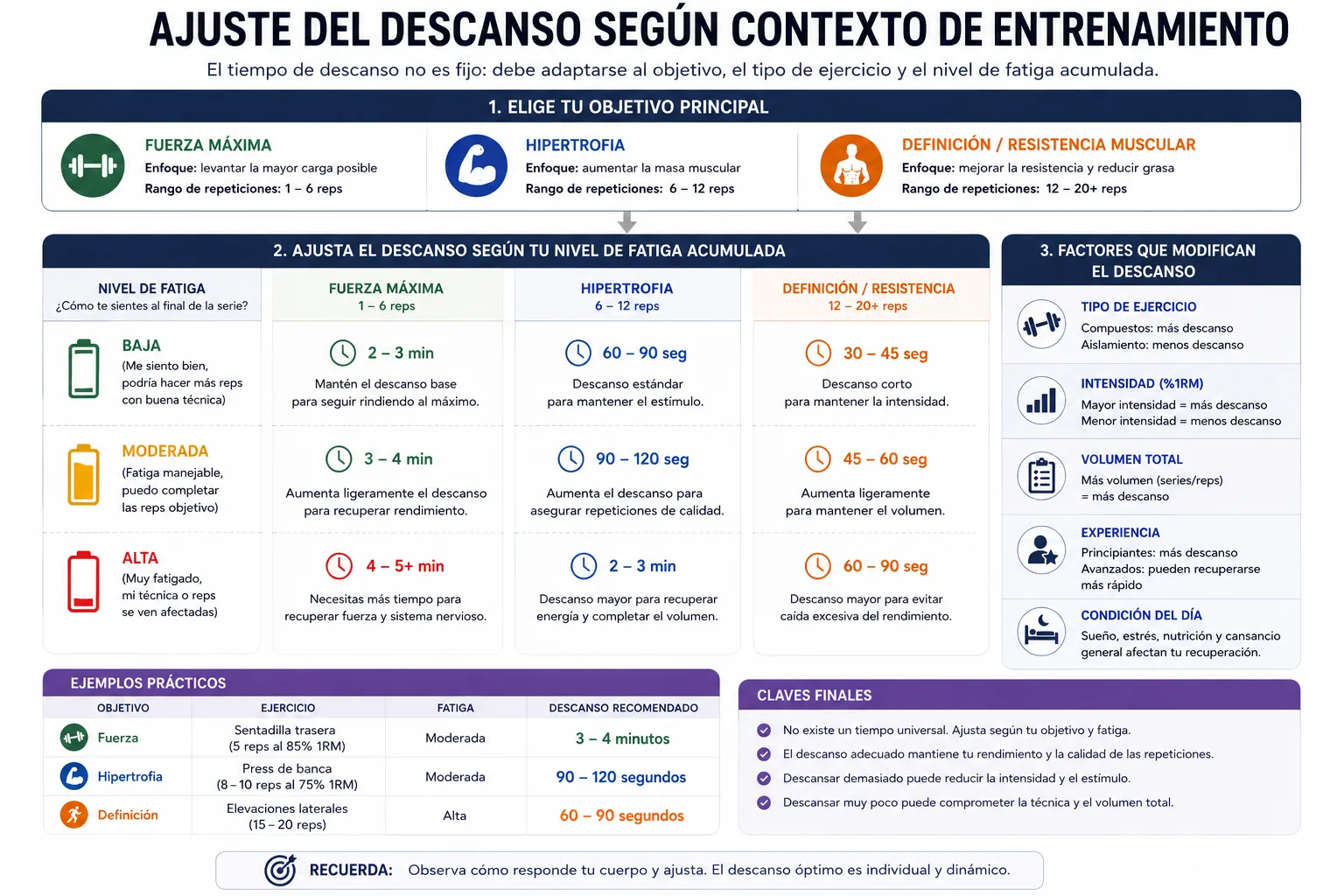
Rest should not be fixed forever. Must adapt:
On high energy days:
- You can use slightly shorter breaks
- Maintaining stable performance
On days of fatigue:
- You need more rest to maintain quality
- Prioritize performance over density
In strength phases:
- Longer breaks
- Maximum neuromuscular recovery
In definition phases:
- Moderate breaks
- Maintain intensity without losing volume
Simple practical strategy
If you want a functional and applicable rule:
- Large exercises: 2–4 minutes
- Medium exercises: 1.5–3 minutes
- Small exercises: 60–90 seconds
From there, adjust according to actual performance:
- If you drop in reps → rest more
- If you keep easy performance → you can slightly reduce
Conclusion
The rest between sets is not a minor detail, but a structural variable of the training. Determines the quality of the stimulus, the ability to progress and the efficiency of each session.
It's not about resting as little as possible or following a rigid timer, but rather finding the point at which you can repeat high-quality effort without losing performance or unnecessarily lengthening the workout.
Training well is not just about how much you lift, but also how much you recover between efforts so you can continue to progress.