Muscle growth is one of the most sought after processes in training, but also one of the most misunderstood. It is often thought that muscle grows quickly if you train hard for a few days or weeks, when in reality hypertrophy is a slow biological adaptation that depends on multiple body systems working together.
To understand how long it takes to grow muscle, you first have to understand what “growing muscle” really means and what is happening inside your body from the moment you train until you start to see physical changes.
What muscle growth really is
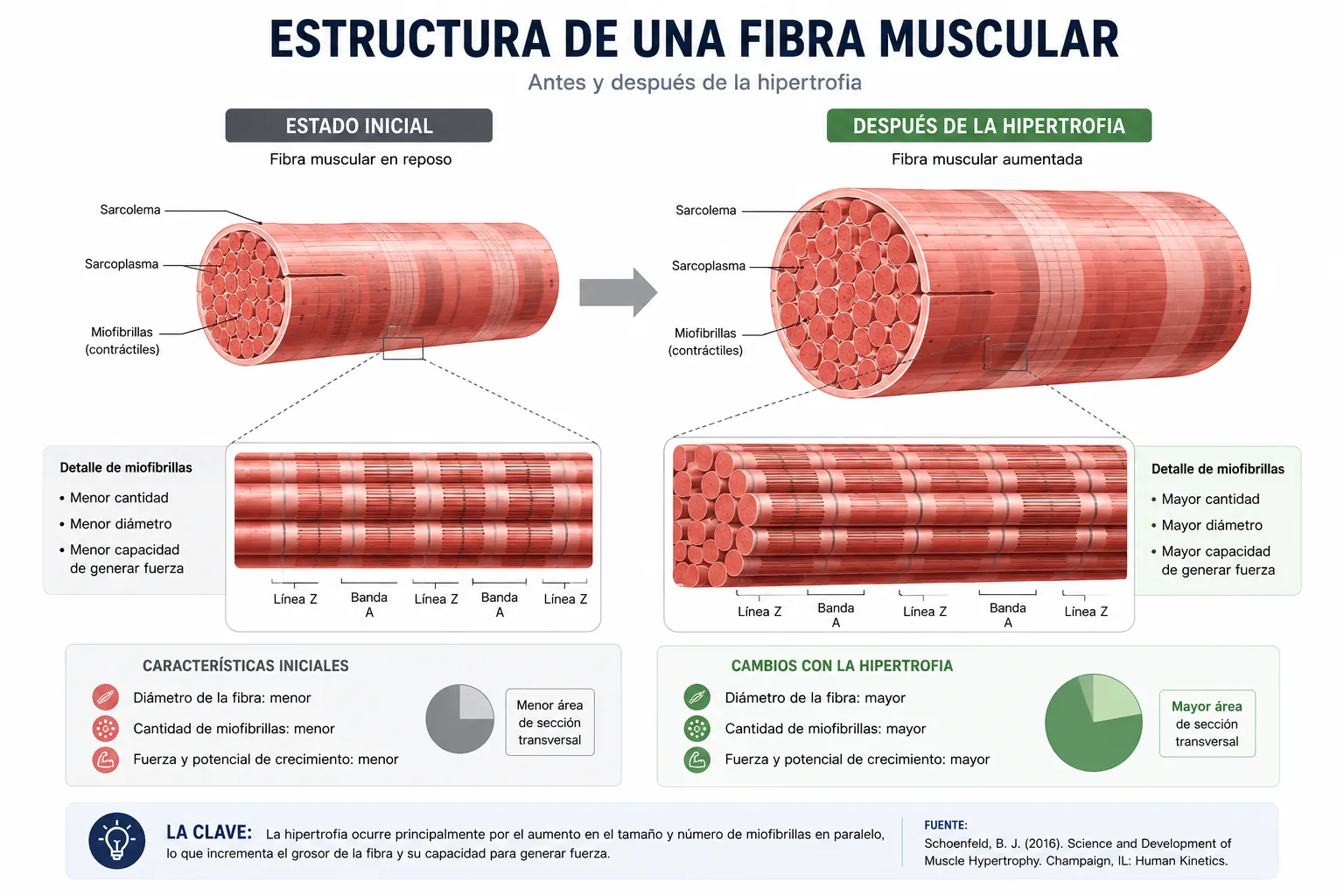
Muscle growth is not just about “looking bigger.” In physiological terms, we talk about hypertrophy, which is the increase in the size of muscle fibers in response to strength or resistance stimuli.
This process includes several adaptations:
- Increase in the size of muscle fibers
- Greater amount of contractile proteins (actin and myosin)
- Better efficiency of the neuromuscular system
- Increased energy reserves within the muscle
It is important to understand that these changes do not occur instantly after a session, but are the result of the accumulation of repeated stimuli over time.
What happens right after training
When you do a strength session, the muscle does not grow at that time. What happens is:
- Microdamage to muscle fibers
- Energy depletion (glycogen)
- Activation of the nervous system
- Signage of repair processes
The body interprets this stimulus as a need to adapt. From there the recovery and reconstruction process begins.
But this reconstruction is not immediate or always visible.
Phases of muscle growth
Muscle growth can be divided into functional phases:
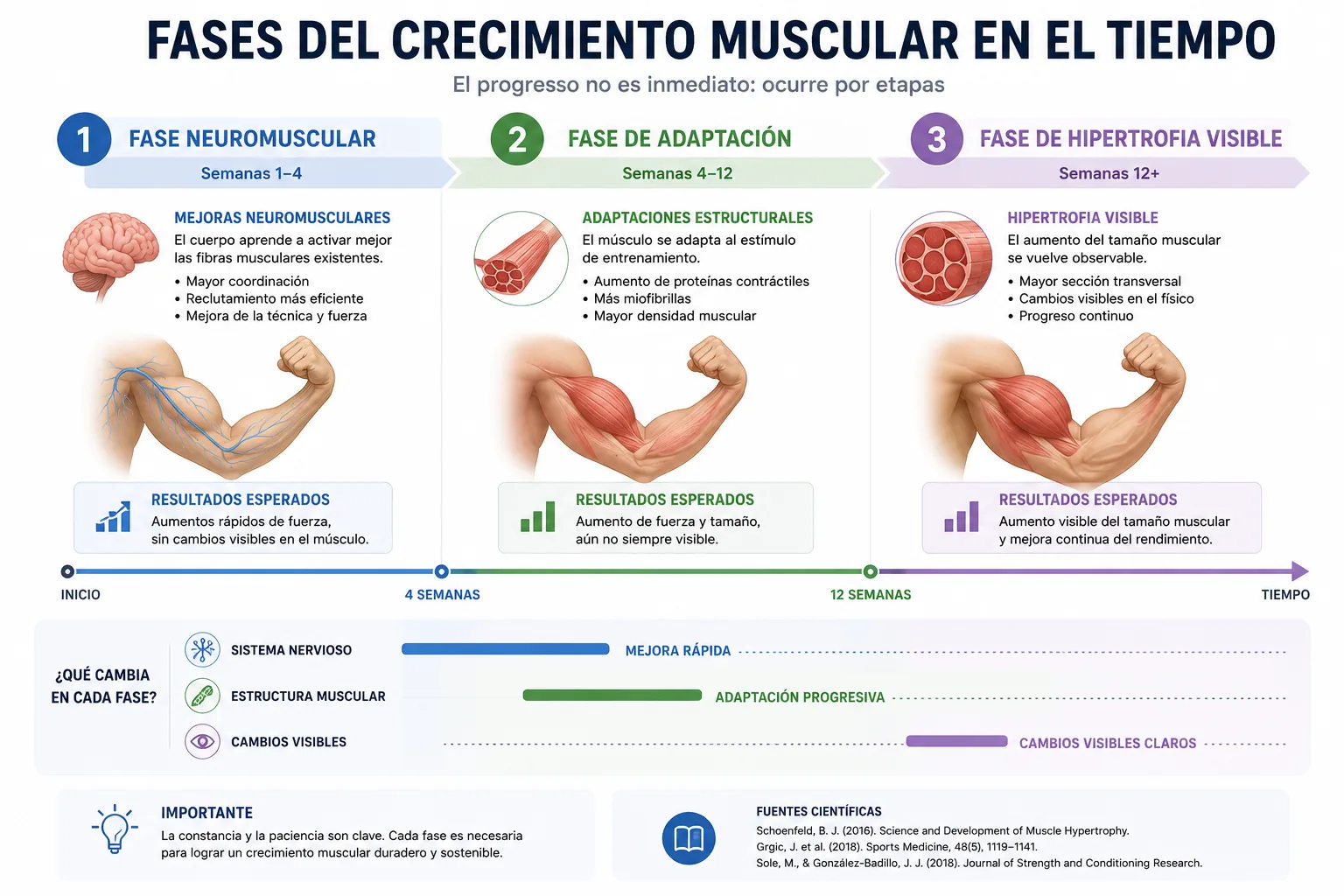
1. Neuromuscular phase (quick start)
During the first weeks of training:
- Improves the brain-muscle connection
- Increases the ability to recruit muscle fibers
- Exercise technique is improved
- Increases strength without big visible changes
Progress here is mainly internal, not visual.
2. Initial structural adaptation phase
After several weeks of constant training:
- The muscle begins to adapt to the repeated stimulus
- Recovery between sessions is optimized
- Small changes begin in muscle volume
These changes can still be difficult to notice with the naked eye, especially if your body fat percentage is medium or high.
3. Visible hypertrophy phase
With sufficient consistency:
- The increase in muscle mass becomes noticeable
- You notice more muscle “density”
- Body measurements change
- Improve body shape
When does muscle really start to grow?
Muscle growth starts from the first workout, but that doesn't mean it's immediately visible or measurable.
In practical terms:
- In the first 2–3 weeks: mainly internal changes
- Between 4–8 weeks: slight changes visible in some cases
- From 8–12 weeks: clearer changes in the mirror
This depends a lot on previous training level, genetics, diet and body fat percentage.
Why strength increases before muscle
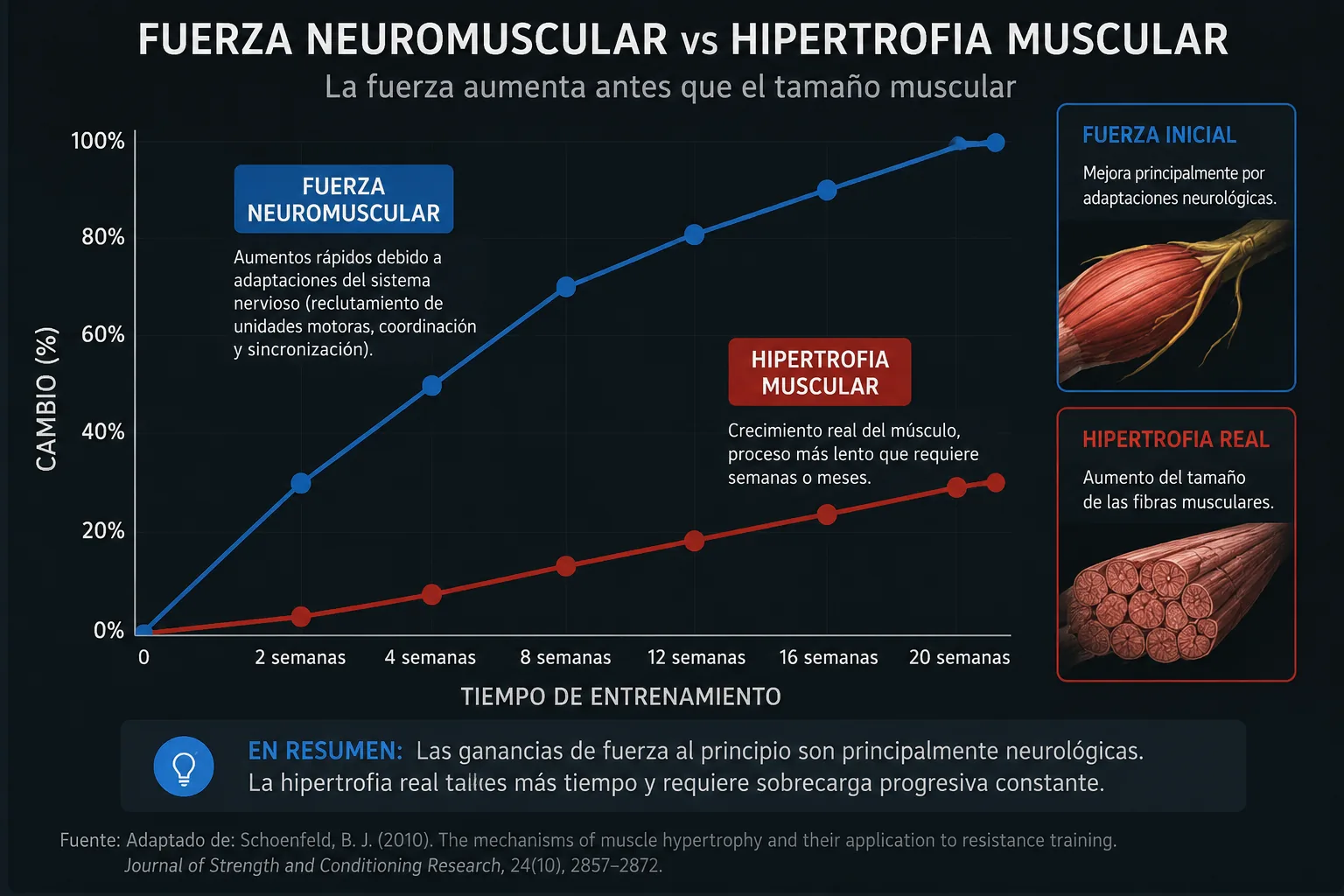
A key phenomenon is that strength increases faster than muscle size at baseline.
This occurs because:
- The nervous system improves its efficiency
- More muscle fibers are recruited per movement
- Neuromuscular “inhibition” is reduced
- Improves exercise coordination
That's why you can lift more weight without having gained much visible muscle.
Factors that influence growth speed
Muscle does not grow at the same rate in all people. There are several determining factors:
1. Training level
- Beginners: respond faster
- Intermediates: slower progress
- Advanced: very fine progress
2. Food
Without enough energy and protein:
- Growth slows
- There may be no significant muscle gain
3. Recovery
Muscle grows outside the gym:
- Adequate sleep
- Rest between sessions
- Stress management
4. Quality of training
Not all training stimulates the same:
- Load progression
- Correct technique
- Proper volume
Why doesn't it seem like you're growing?
Many people feel that they are not making progress even though they are making progress. This occurs because:
- Changes too gradual
- Lack of monitoring of measures
- Daily comparison in front of the mirror
- Hydration and body fat variations
Real progress is cumulative, not immediate.
First partial summary
The muscle begins to adapt from the first workout, but visible changes take weeks or months to appear.
In general:
- Neuromuscular improvement: first weeks
- Initial adaptation: 4–8 weeks
- Visible changes: 8–12 weeks or more
Muscle growth is a progressive process, not a sudden change.
How long does it take for muscle to grow?
In the first part we saw what hypertrophy really is, what happens after training and why the initial changes are mainly neuromuscular before becoming visible. Now it's time to get to the most practical part: how much muscle can you really gain over time, what rhythms are realistic, and what factors speed up or slow down the process.
Real rate of muscle gain
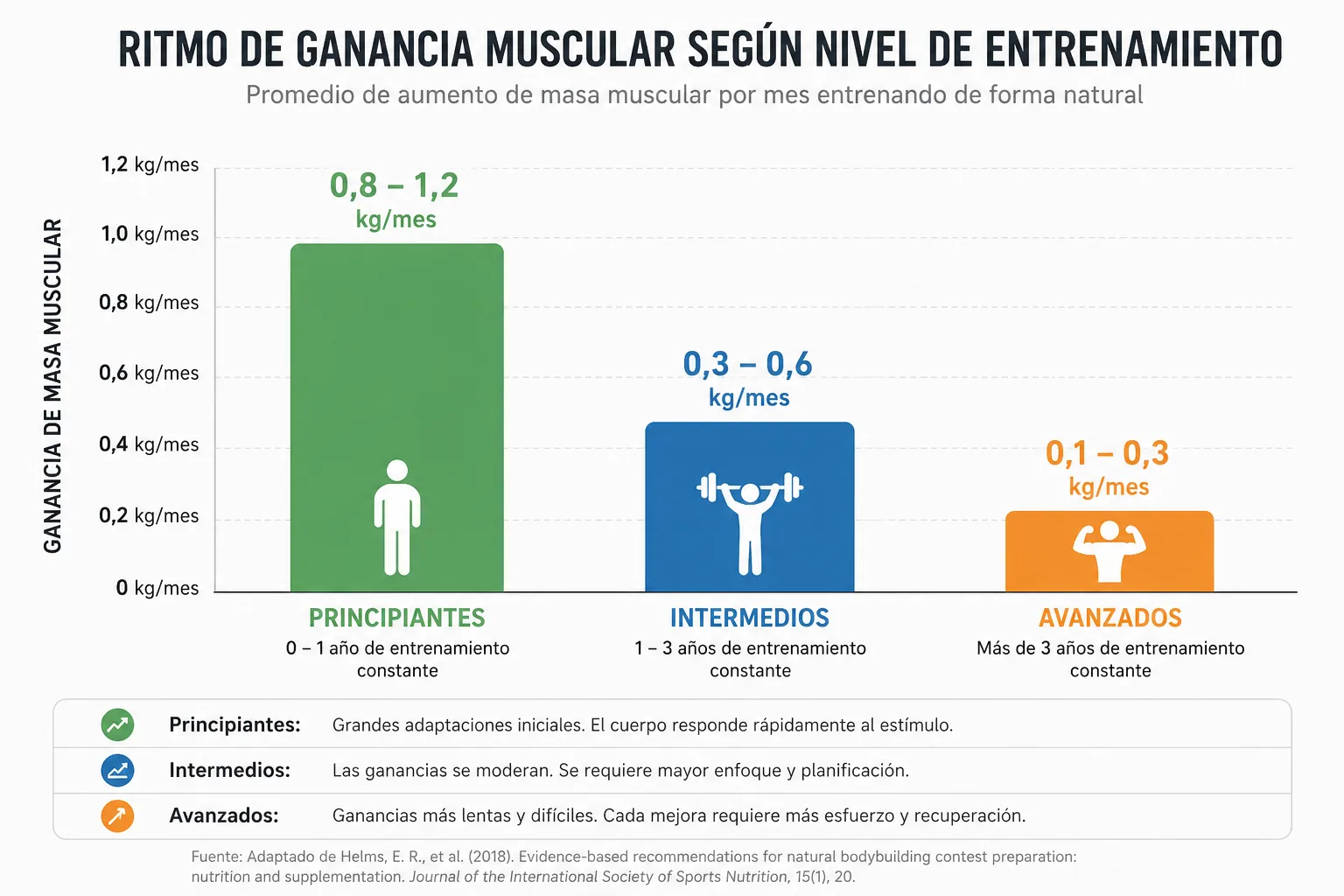
Muscle growth is not linear or the same for everyone. It depends on training level, genetics, diet and consistency. Even so, quite realistic ranges can be given under well-optimized conditions:
Beginners
- Approximately 0.5 to 1 kg of muscle per month in initial phases
- They respond very quickly to the training stimulus
- Much of the initial progress is a mixture of muscle + neuromuscular adaptations
Intermediates
- Approximately 0.25 to 0.5 kg per month
- Progress starts to slow down
- More precision is needed in training and diet
Advanced
- Approximately 0.1 to 0.25 kg per month
- Very slow and difficult progress
- Small changes require a lot of consistency
Why growth slows down over time
The body adapts to the training stimulus. The more trained you are:
- Less response to basic stimuli
- Increased need for volume and precision
- More difficult to generate progressive overload
- Slower pace of adaptation
This is completely normal and does not mean that you stop progressing, but rather that the progress becomes finer.
Factors that accelerate muscle growth
1. Progressive overload
It is the most important factor:
- Gain weight gradually
- Increase repetitions with the same weight
- Improve technique and control
Without progression there is not enough stimulus to grow.
2. Proper nutrition
To build muscle the body needs resources:
- Sufficient protein (approx. 1.6–2.2 g/kg)
- Calories in maintenance or slight surplus
- Enough carbohydrates to perform in training
Without energy, the body prioritizes maintaining basic functions over building new tissue.
3. Rest and sleep
Growth occurs mainly during recovery:
- 7–9 hours of sleep
- Recovery between sessions
- Avoid chronic fatigue
Training stimulates, but growth happens outside the gym.
4. Long-term consistency
The most important factor of all:
- Train months and years, not days
- Maintain stable routine
- Avoid constant changes without real progression
Errors that slow muscle growth
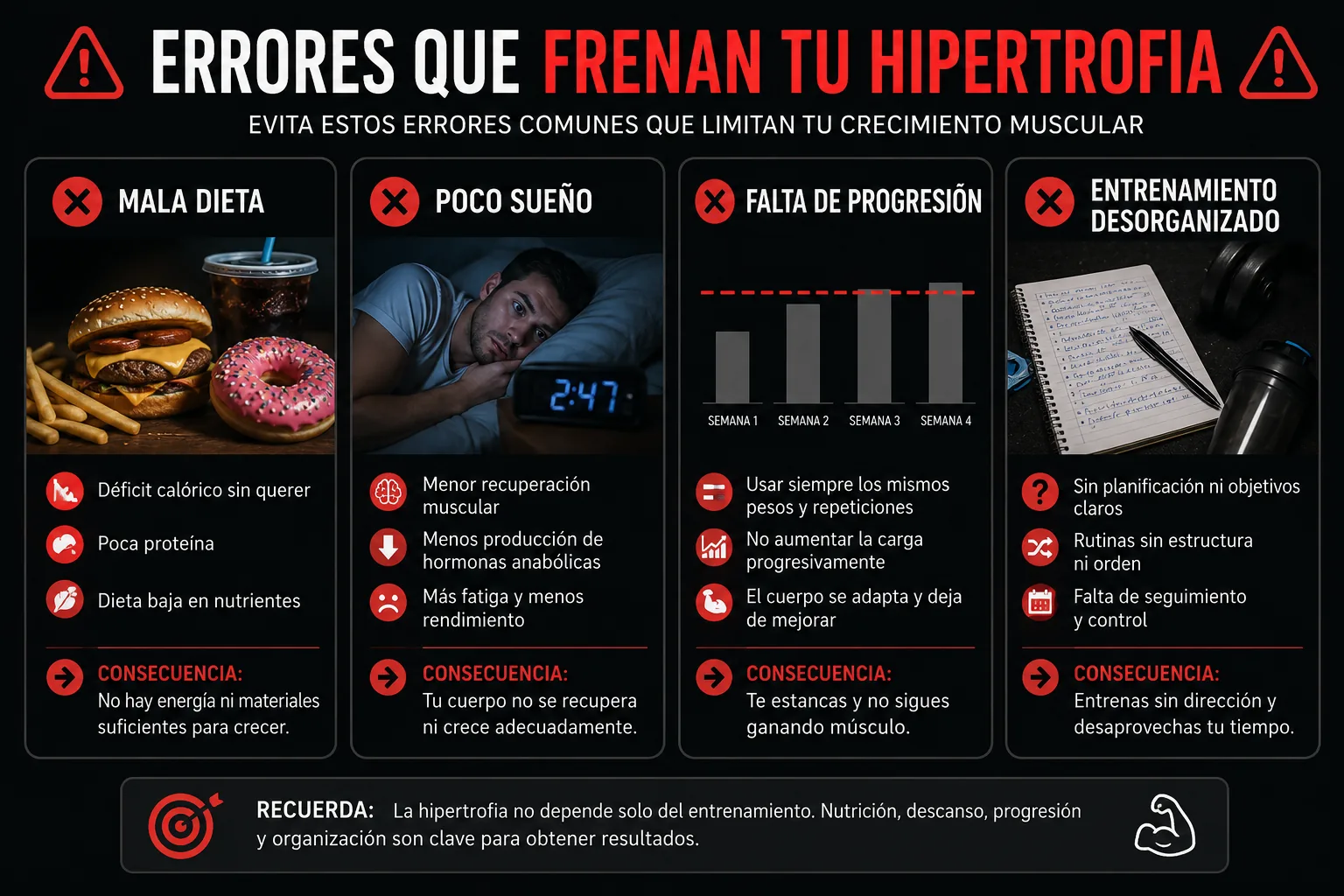
1. Not progressing in loads
If you always do the same thing:
- The body has no reason to adapt
- Growth stagnates
2. Eating too little
A constant calorie deficit can:
- Limit muscle gain
- Reduce performance
- Make recovery difficult
3. Train without structure
Typical problems:
- Random exercises
- Poorly distributed volume
- Lack of follow-up
4. Sleep little
Insufficient sleep causes:
- Worst recovery
- Lower protein synthesis
- More accumulated fatigue
Why progress seems slower than it is
Actual muscle growth is difficult to perceive for several reasons:
1. Gradual changes
Muscle grows little by little, not explosively.
2. Visual adaptation
Seeing yourself every day makes you not notice small differences.
3. Fat and water variations
The physical appearance constantly changes due to non-muscular factors.
When is the physical change really noticeable?
In general terms:
- 3–4 weeks: internal changes
- 6–8 weeks: slight changes visible
- 8–12 weeks: clear changes in some cases
- 6–12 months: evident transformations
Strategy to maximize growth
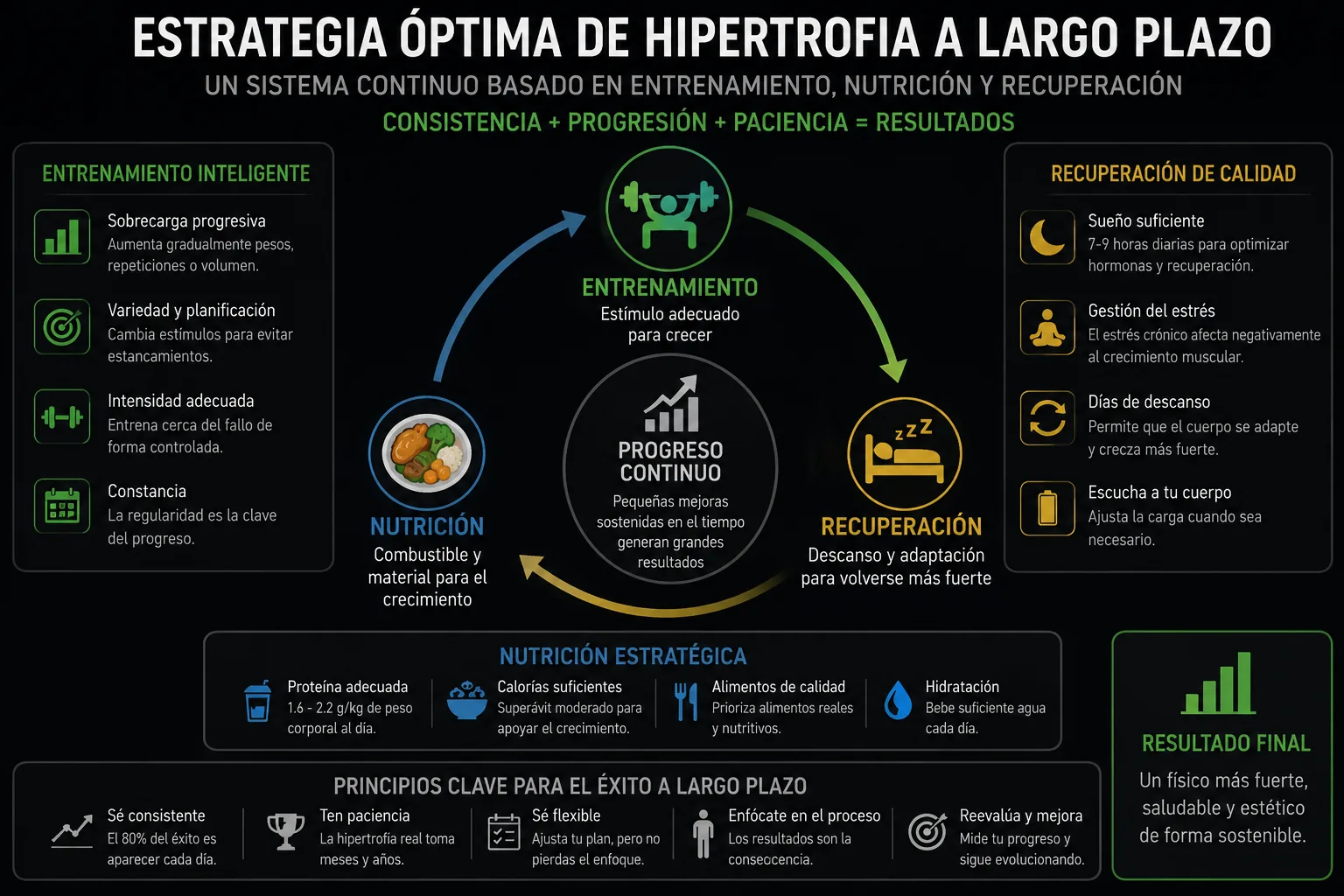
If the goal is to gain muscle efficiently:
- Train with real progression
- Maintain sufficient but controlled volume
- Ensures adequate daily protein
- Eat in maintenance or slight surplus
- Get good sleep consistently
- Evaluate progress every week, not every day
Conclusion
The muscle does not grow quickly, but it does grow constantly if the stimulus is adequate and maintained over time.
In summary:
- Growth starts from the first training, but it is not seen immediately
- Visible changes usually appear after several weeks or months
- Real progress depends more on consistency than on specific intensity
The deciding factor is not how much you train on a given day, but how long you are able to maintain a system that forces the body to adapt.