The length of a training routine is one of the most misunderstood topics in the gym. Many people assume that “more time = better training,” when in reality the effectiveness of a routine depends more on the quality of the stimulus than the total time invested.
A good routine does not have an exact universal duration, but it does have optimal ranges depending on the objective, the level of training and the structure of the session. Additionally, there is a key factor that almost no one controls: training density, that is, how much actual work you do per unit of time.
What determines the duration of a routine
The total duration of a workout depends on four main variables:
1. Number of exercises
The more exercises you include, the more time you will need. However, adding exercises without criteria usually reduces the quality of the stimulus.
2. Series per exercise
More sets mean more volume, but also more accumulated fatigue and more rest needed.
3. Rest time between sets
As we already saw, the rest can vary between 60 seconds and 4 minutes or more, depending on the objective.
4. Training intensity
Training near muscle failure or with high loads requires more recovery between sets.
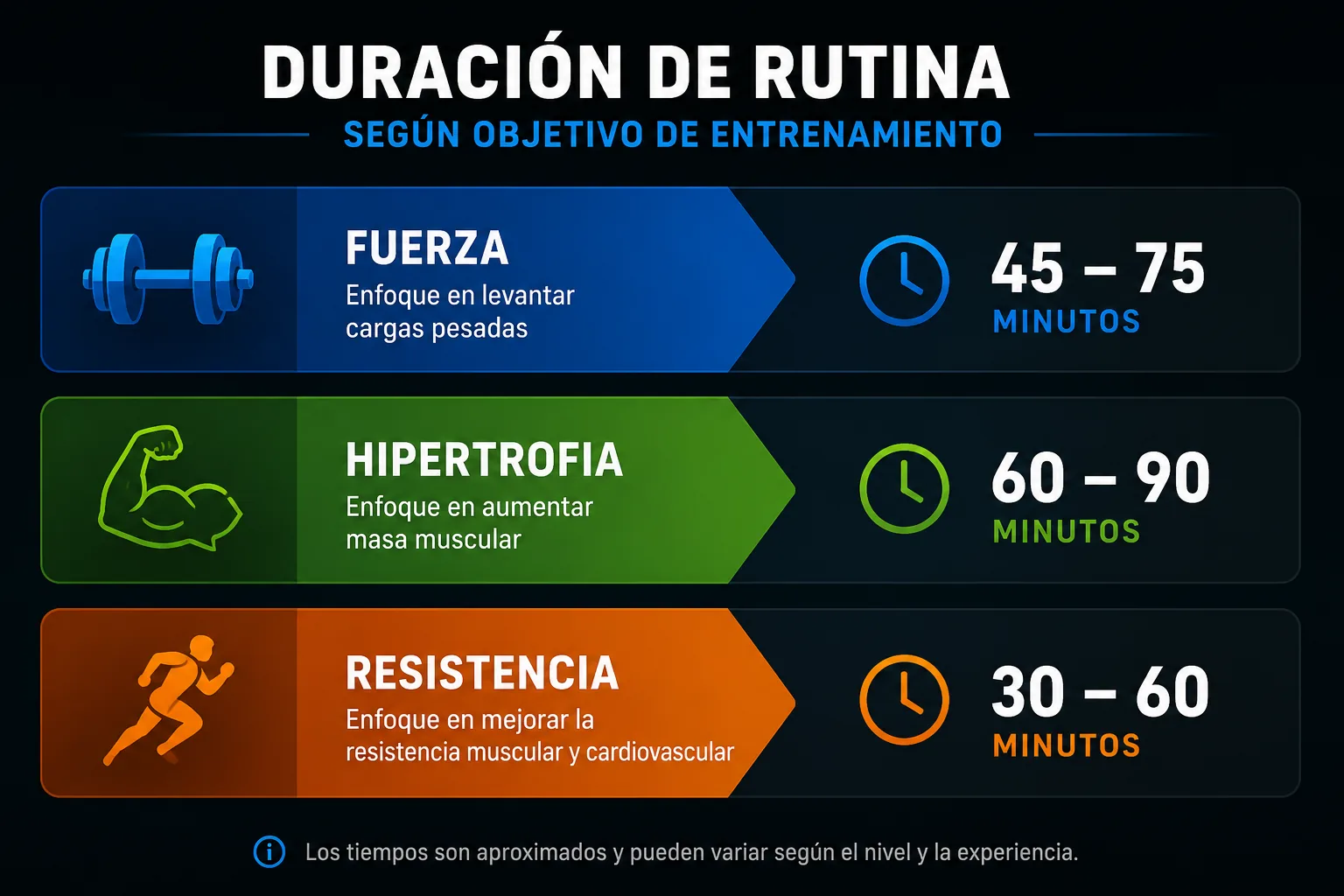
Ideal duration depending on the objective
Although there is no fixed rule, there are fairly solid practical ranges.
1. Hypertrophy (gain muscle)
- Typical duration: 45 to 75 minutes
In hypertrophy training, the goal is to accumulate enough effective volume without compromising the quality of the sets.
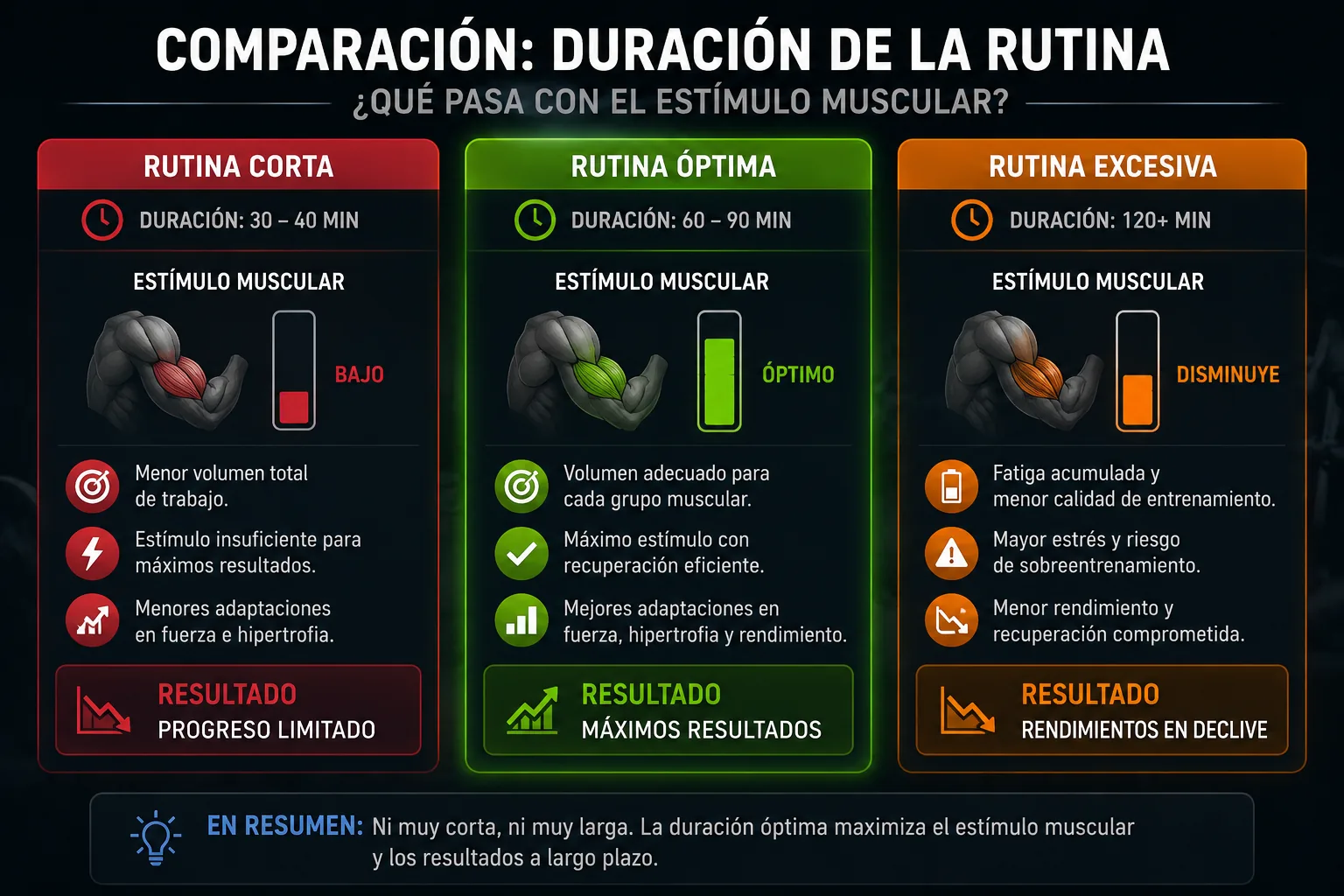
Training that is too long can cause:
- Loss of intensity
- Acute drop in hormonal performance
- Excessive accumulated fatigue
Workouts that are too short may not generate enough stimulus.
2. Maximum force
- Typical duration: 60 to 90 minutes
Strength training requires:
- long breaks
- heavy series
- High technical concentration
That is why it is usually longer, although with fewer total repetitions.
3. Muscle endurance or conditioning
- Typical duration: 30 to 60 minutes
Here it is prioritized:
- Work density
- short breaks
- High metabolic fatigue
The most common mistake: training too long
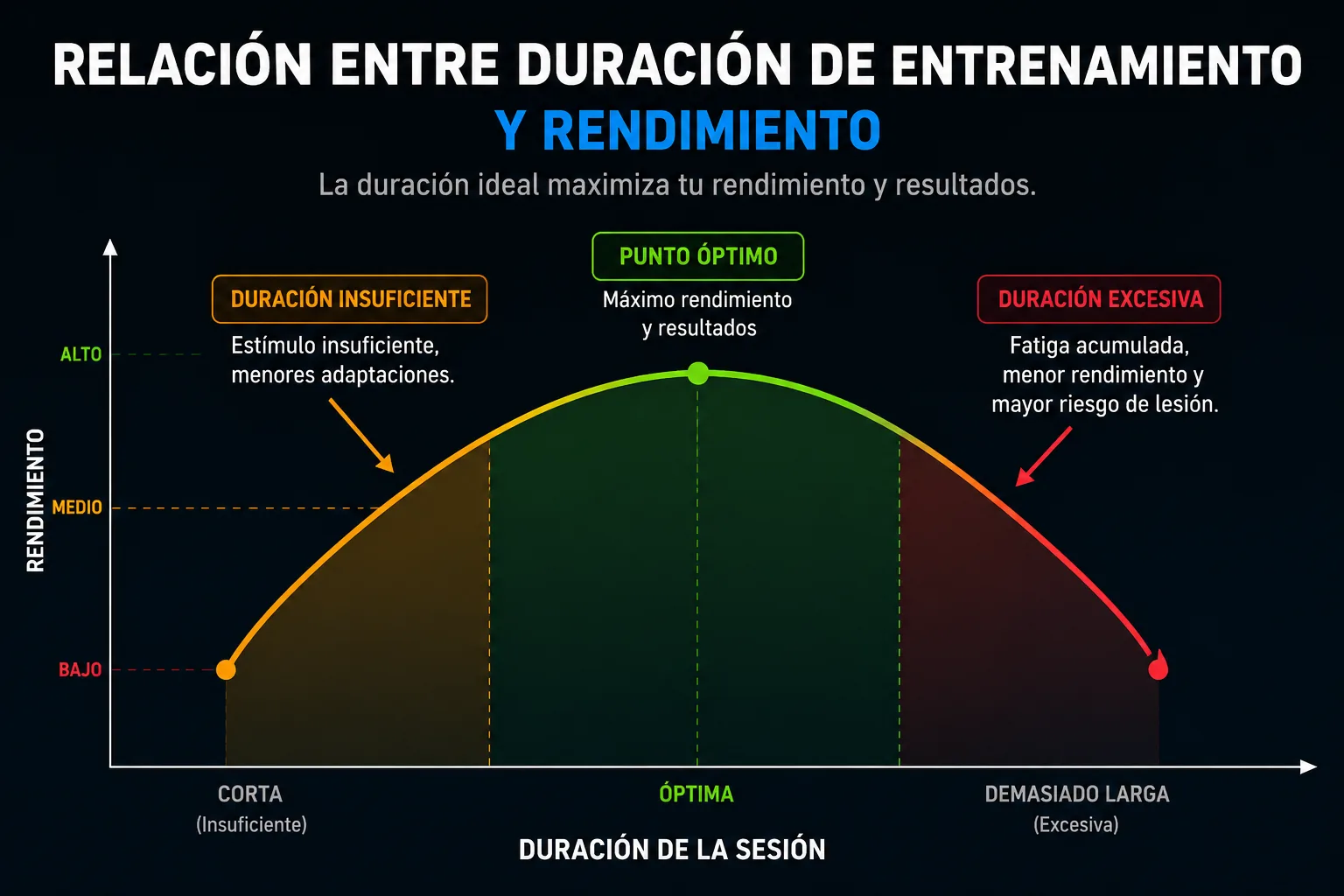
One of the most common mistakes in the gym is thinking that a 2-hour routine is automatically better.
In reality, sessions that are too long usually generate:
1. Performance drop
After a certain point, fatigue reduces the quality of the sets.
2. Loss of concentration
The technique worsens with mental fatigue.
3. Lower actual intensity
Even if you are there “more time”, the effective stimulus may be less.
4. Useless excess volume
More is not always better if the latest series are of low quality.
The importance of training density
Density is one of the most important factors to understand the actual duration of a routine.
It is defined as:
Effective work / total training time
Two people can train 60 minutes, but:
- One does 12 effective series with good rest
- Another does 8 sets with unnecessary long rests.
The first has greater training density.
What happens if you train too little
A routine that is too short can also be a problem if:
- You don't accumulate enough volume
- You don't give enough stimulation to the muscle
- You stay away from real effort
This is common in beginners who do 20–30 minute routines without structure.
Factors that lengthen or shorten the routine
Factors that lengthen it:
- Long rests (strength)
- Many accessory exercises
- Very fragmented training
Factors that shorten it:
- Less but more intense exercises
- Superseries or density methods
- Controlled breaks
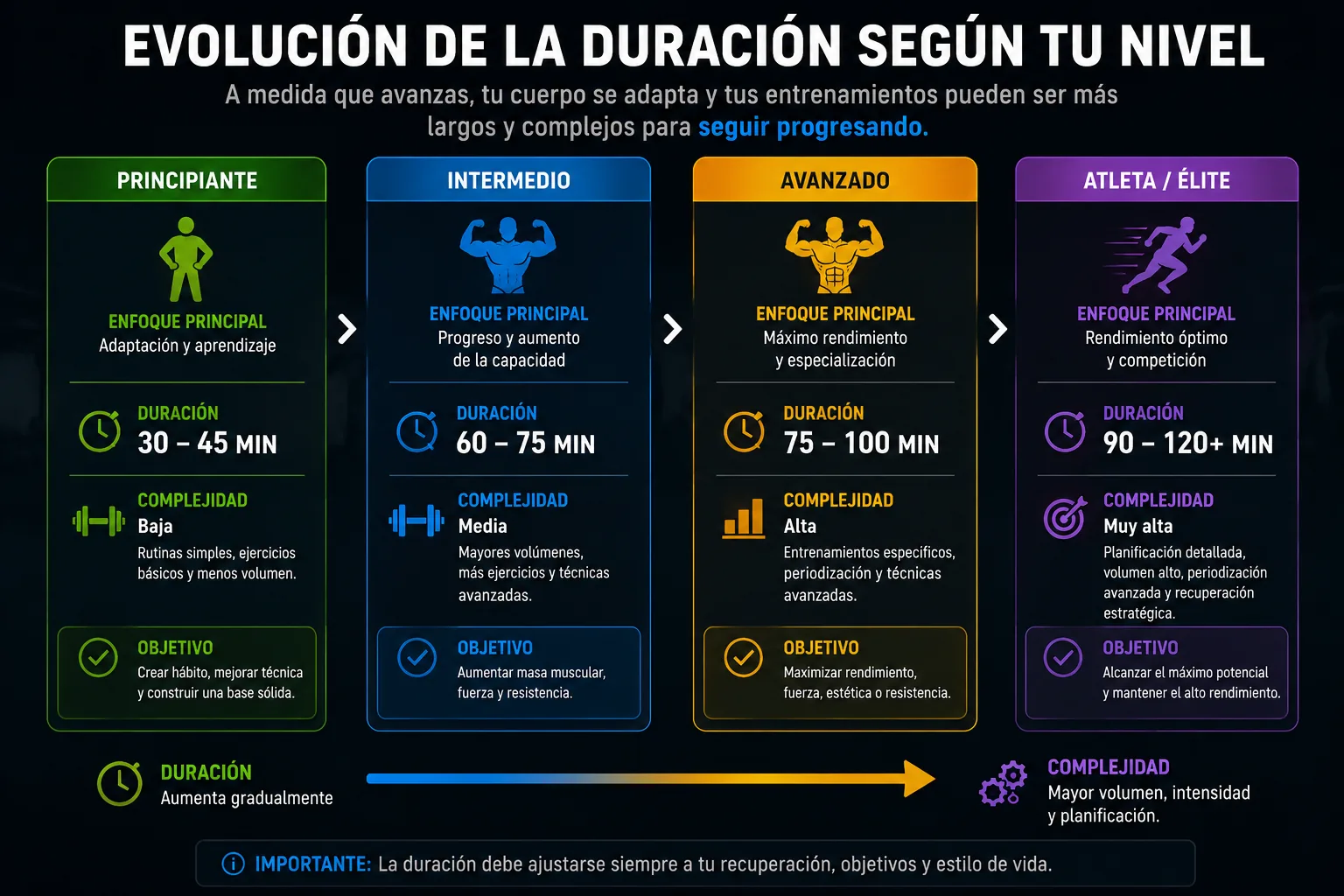
Relationship between experience and duration
The ideal duration also changes with the level:
Beginner:
- Less exercises
- Lower volume
- 40–60 minutes is usually enough
Intermediate:
- More volume
- Better rest control
- 50–75 minutes
Advanced:
- Greater specialization
- More structured sessions
- 60–90 minutes (sometimes more at strength)
First partial summary
The duration of a routine is not a fixed number, but rather the result of the training structure.
In general:
- 45–75 minutes is the most efficient range for hypertrophy
- Strength may require a little more time
- Less than 40 minutes may be insufficient if it is not well structured.
- More than 90 minutes is usually unnecessary in most cases
How long does a good routine last?
In the first part we saw what factors determine the duration of a workout and the general ranges depending on the objective. Now it's time to do the most important thing: how to optimize your actual time in the gym, how to know if you are training too much or too little, and how to structure efficient sessions without losing results.
How to optimize the duration of your training
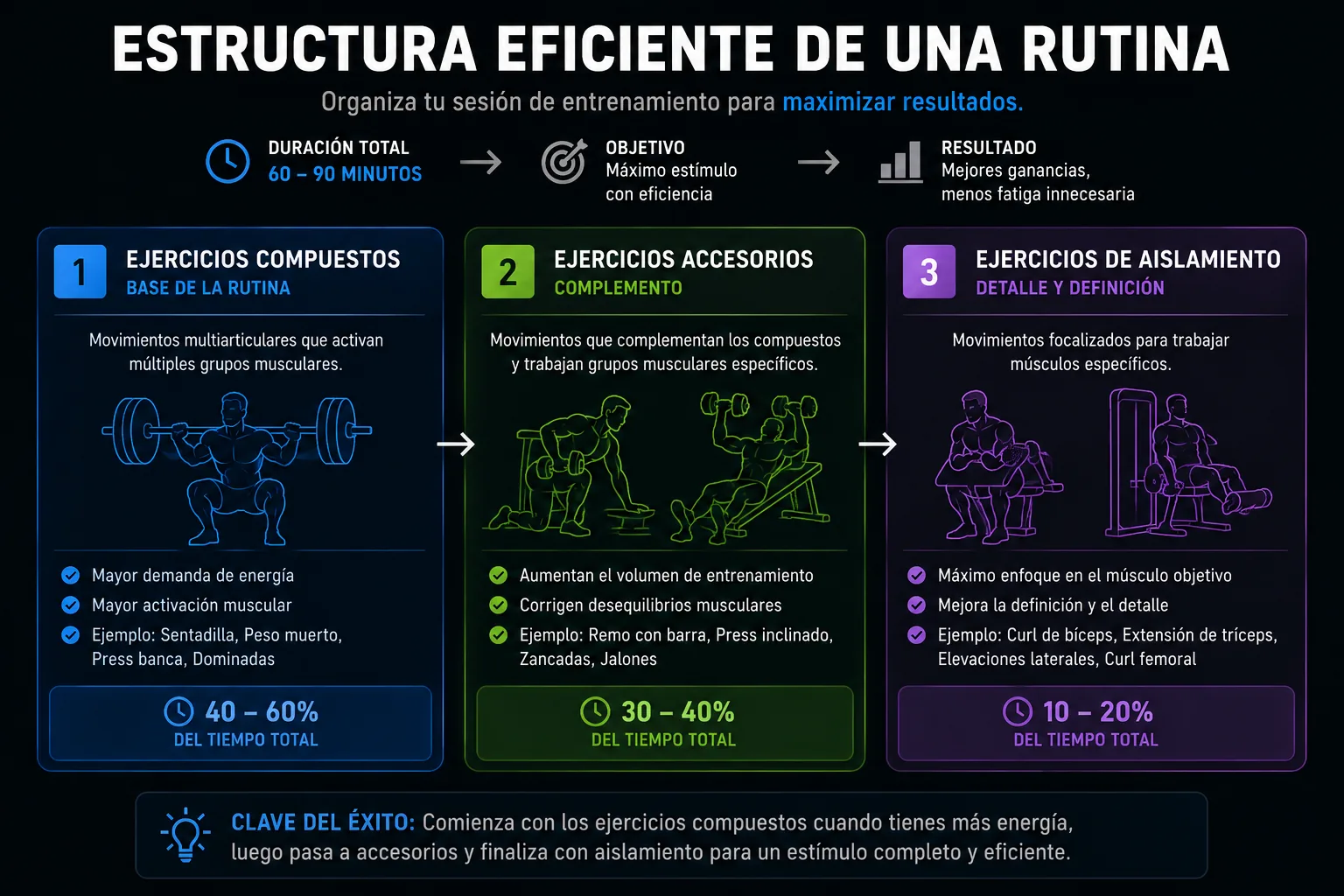
An efficient routine is neither the longest nor the shortest, but rather the one that maximizes the stimulus per minute.
This is achieved by adjusting three variables:
1. Exercise selection
Not all exercises provide the same value. In a well-designed routine:
- Compound exercises are the foundation
- Accessory exercises complement
- Redundant exercises are eliminated
If you add exercises without a clear function, you lengthen the session without improving results.
2. Rest control
Rest is the factor that most alters the total duration.
- Long breaks → more total time, more performance
- Short breaks → less total time, but possible loss of performance
The correct balance depends on the objective, as we already saw in the topic of series.
3. Order of exercises
The order directly affects efficiency:
- First: more demanding exercises (squat, bench press)
- After: accessories
- In the end: isolation or metabolic work
If you mix the order without criteria, the session becomes longer and inefficient.
Example of efficient routine (hypertrophy)
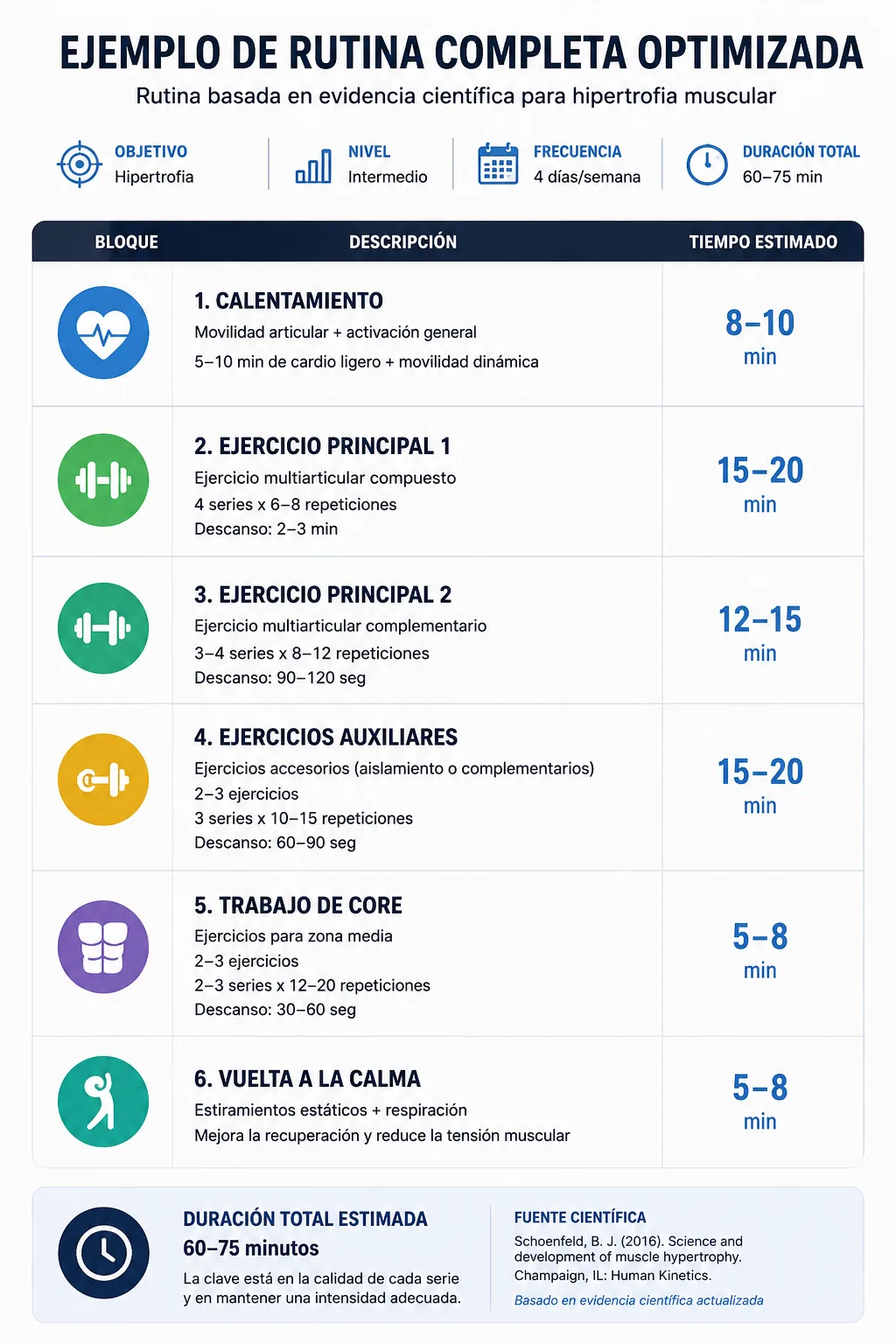
A well-optimized hypertrophy routine might look like this:
- Bench press: 3–4 sets (2–3 min rest)
- Barbell row: 3–4 sets (2–3 min rest)
- Incline dumbbell press: 3 sets (1.5–2 min rest)
- Chest pulldown: 3 sets (1.5–2 min rest)
- Lateral raises: 3 sets (60–90 s)
- Biceps curl: 3 sets (60–90 s)
- Triceps pulley: 3 sets (60–90 s)
Approximate total duration: 55–75 minutes.
How to know if your routine is too long
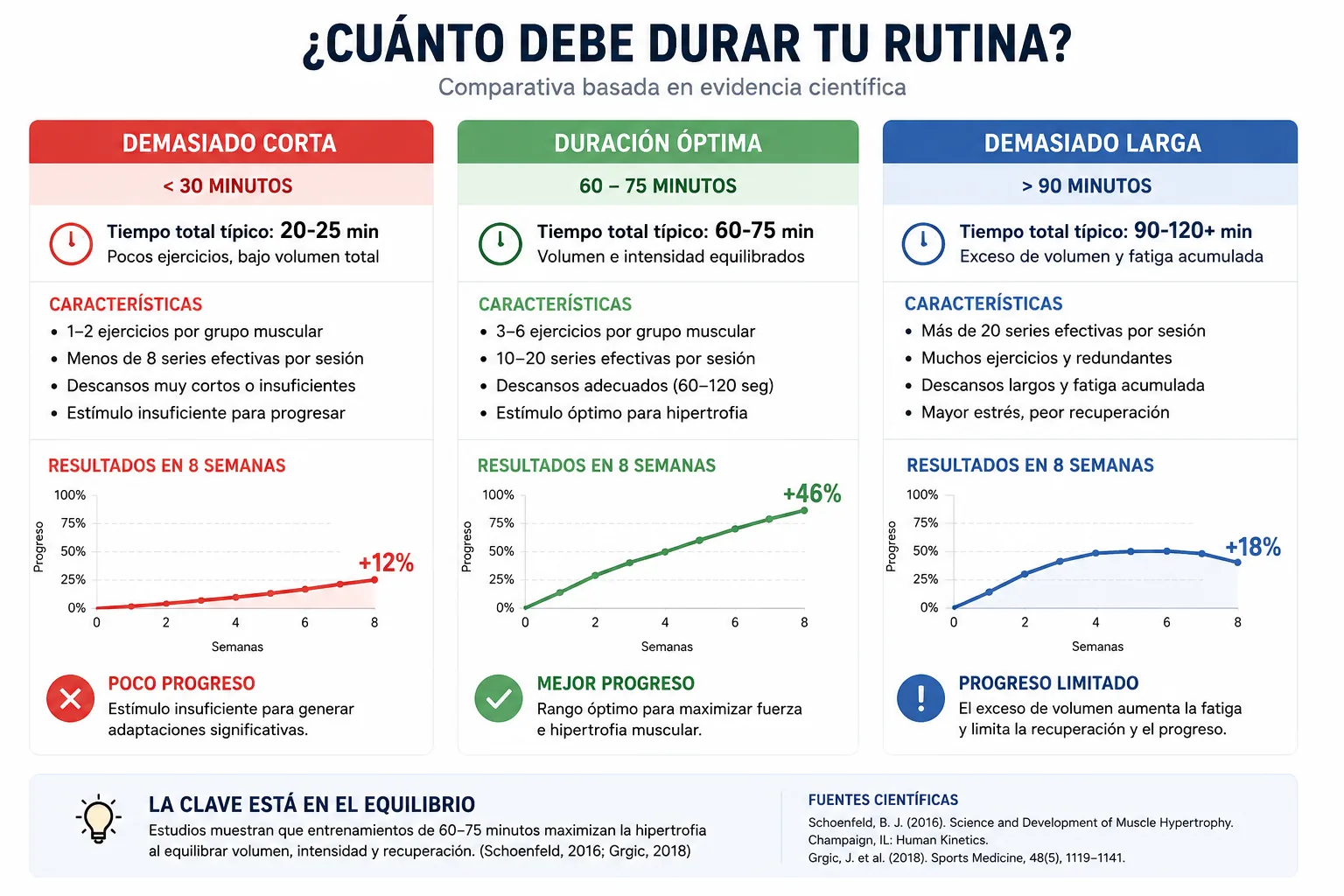
An excessive routine usually has clear signs:
1. Intensity drop
If in the second half of the training:
- You use less weight for no reason
- You don't keep repetitions
- You feel disproportionate fatigue
2. Loss of technical quality
When the technique worsens noticeably, the stimulus is no longer efficient.
3. Useless volume
If the last few sets are too light or uncontrolled, you are probably doing more than necessary.
How to know if your routine is too short
A routine that is too short can also limit results:
1. Lack of weekly volume
There is not enough encouragement to progress.
2. Stagnation
There is no progression in loads or repetitions.
3. Feeling of “not having trained”
Although this is not a perfect criterion, it usually indicates low intensity or insufficient volume.
The role of the objective in duration
The ideal duration changes depending on what you are looking for:
Hypertrophy
- Average duration
- Moderate-high volume
- Controlled breaks
Force
- More time for long breaks
- Fewer total repetitions
Definition
- Similar to hypertrophy, but with more fatigue control
- Possible slight volume reduction
Training density: the real key
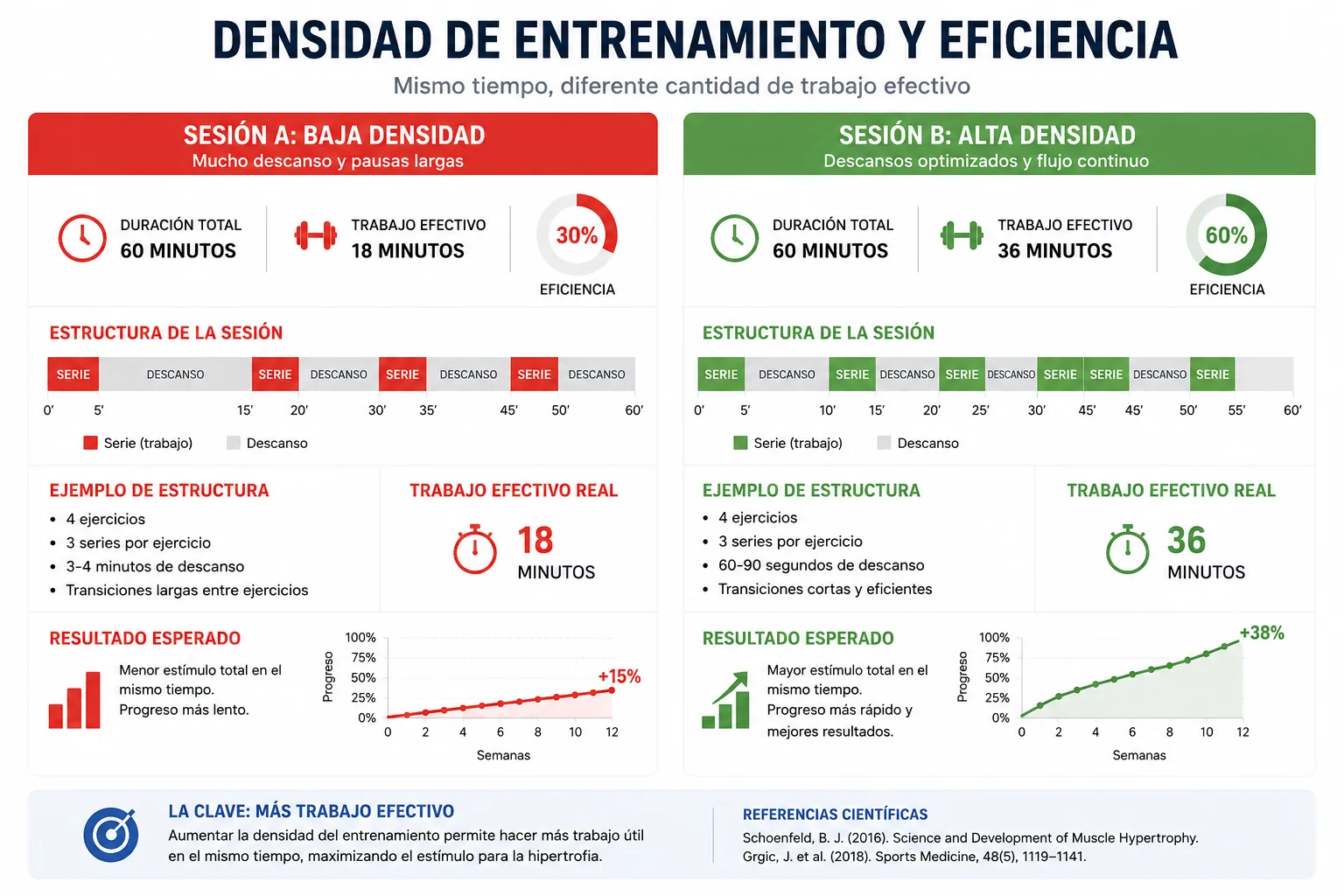
Density is not how long you train, but how much useful work you do in that time.
You can have:
- 60 minutes with low density → little stimulation
- 60 minutes with high density → excellent stimulation
Factors that increase density:
- Optimized breaks
- Less down time
- Well organized exercises
- Quick transitions
Advanced errors that lengthen the routine without improving results
1. Too many accessory exercises
More is not always better. After a certain point, additional volume does not bring improvements.
2. Uncontrolled breaks
Using your phone between sets can double session time without improving performance.
3. Lack of planning
Improvising at the gym lengthens the routine unnecessarily.
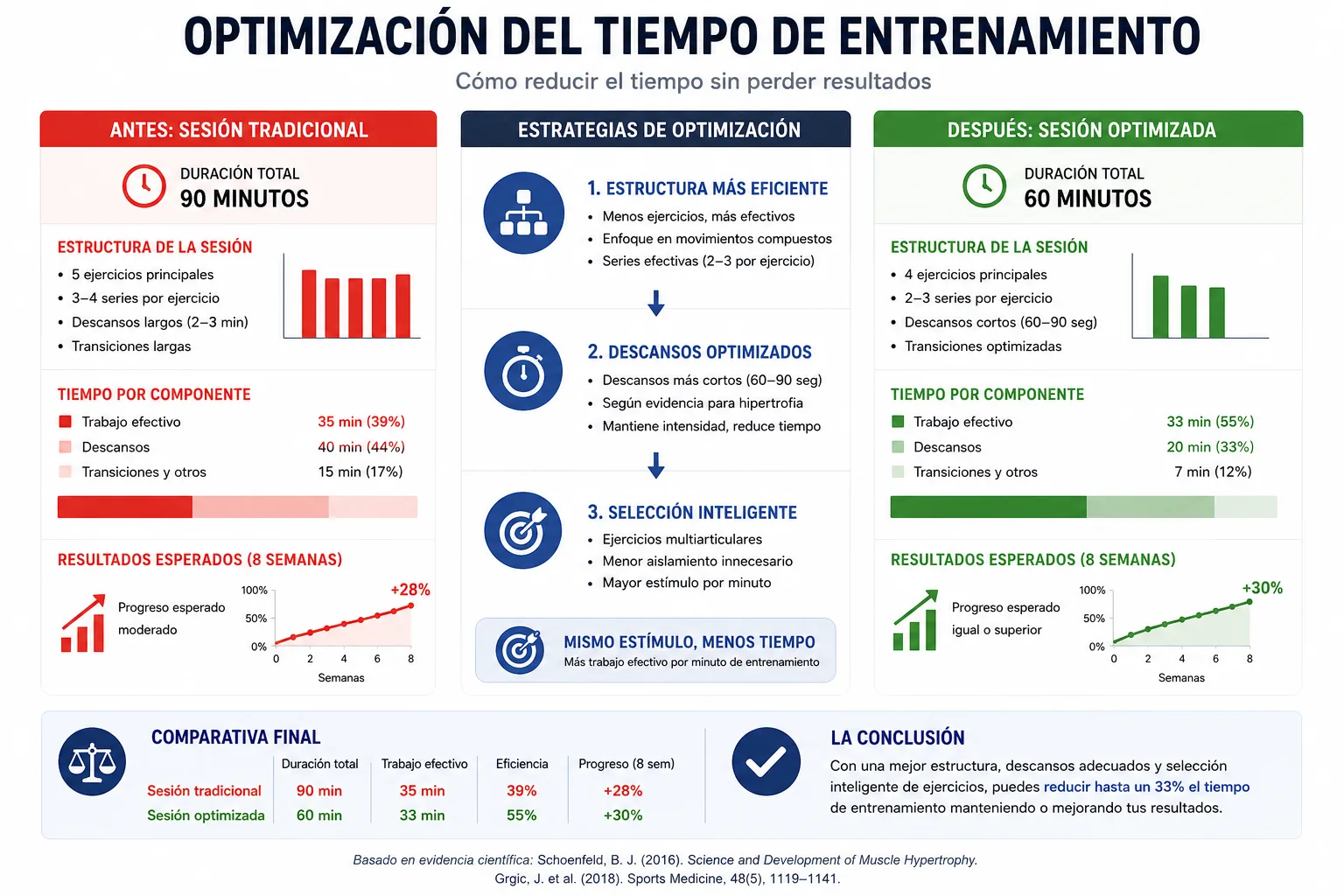
How to reduce time without losing results
- Maintain priority compound exercises
- Reduce redundancies
- Control breaks according to objective
- Avoid distractions
- Use fixed block structure
Conclusion
The duration of a routine is not what determines its effectiveness, but the quality of the work performed within it.
In most cases:
- 45 to 75 minutes is the most efficient range for hypertrophy
- Longer routines only make sense if the volume is well justified
- Shorter routines can work if the intensity is high and the structure is correct
The goal is not to train longer, but to train better in the time available.
A well-designed routine is not the longest, but the one that achieves the most progress with the least amount of unnecessary work.