Walking is one of the most powerful tools for losing body fat, but also one of the most misunderstood. Most people underestimate it because it does not “feel intense”, it does not leave sore muscles and it does not generate the typical sensation of hard training. However, from the point of view of human metabolism, walking has an enormous impact because it acts on the most determining component of daily energy expenditure: total accumulated movement.
To truly understand whether walking makes you lose weight, it is not enough to say “it burns calories.” You have to analyze how it interacts with the entire body system: total energy expenditure, metabolic adaptation, daily behavior, and long-term sustainability.
1. The principle that governs everything: energy balance
Fat loss comes down to a simple equation:
Body fat ↓ when energy expenditure exceeds intake for long enough
But this equation is misleading if it is oversimplified, because energy expenditure has multiple components:
- Basal metabolism (energy for living)
- Food thermogenesis
- Structured exercise
- daily spontaneous activity
This is where the most important concept of the article comes in:
The body does not respond to sessions, it responds to averages.
And within that average, the most variable factor between people is unstructured daily movement.
That component is the NEAT NEAT.
2. Why walking is much more important than it seems
Walking is not “light cardio.” It is a way to manipulate energy expenditure without generating significant physiological stress.
It has 4 key metabolic advantages:
1. Low systemic fatigue
Does not generate significant recovery debt.
2. High repeatability
It can be done every day without negative adaptation.
3. Low joint impact
Allows high volumes without high risk of injury.
4. Integration into daily life
It requires no clothing, equipment or complex planning.
👉 This means that walking does not compete with training, but rather complements it.

4. How many calories does walking burn (deep realistic analysis)
The energy expenditure of walking depends on multiple biomechanical and physiological factors:
- Body weight (direct factor)
- Travel speed (dominant factor)
- Terrain and inclination
- Gait efficiency
- stride length
- Physical condition
More realistic estimates:
~70 kg person
- 4 km/h → 180–220 kcal/h
- 5 km/h → 220–320 kcal/h
- 6–6.5 km/h → 320–450 kcal/h
- Moderate incline → 450–600 kcal/h
But the critical point is not the expense per hour.
The critical point is this:
You can accumulate 1–2 hours of daily walking without interfering with your recovery or performance.
This is what makes it a superior tool on a practical level.
5. The NEAT: the true determinant of the physique
Two people can train the same and eat similarly, but have completely different physiques.
The difference is usually the NEAT:
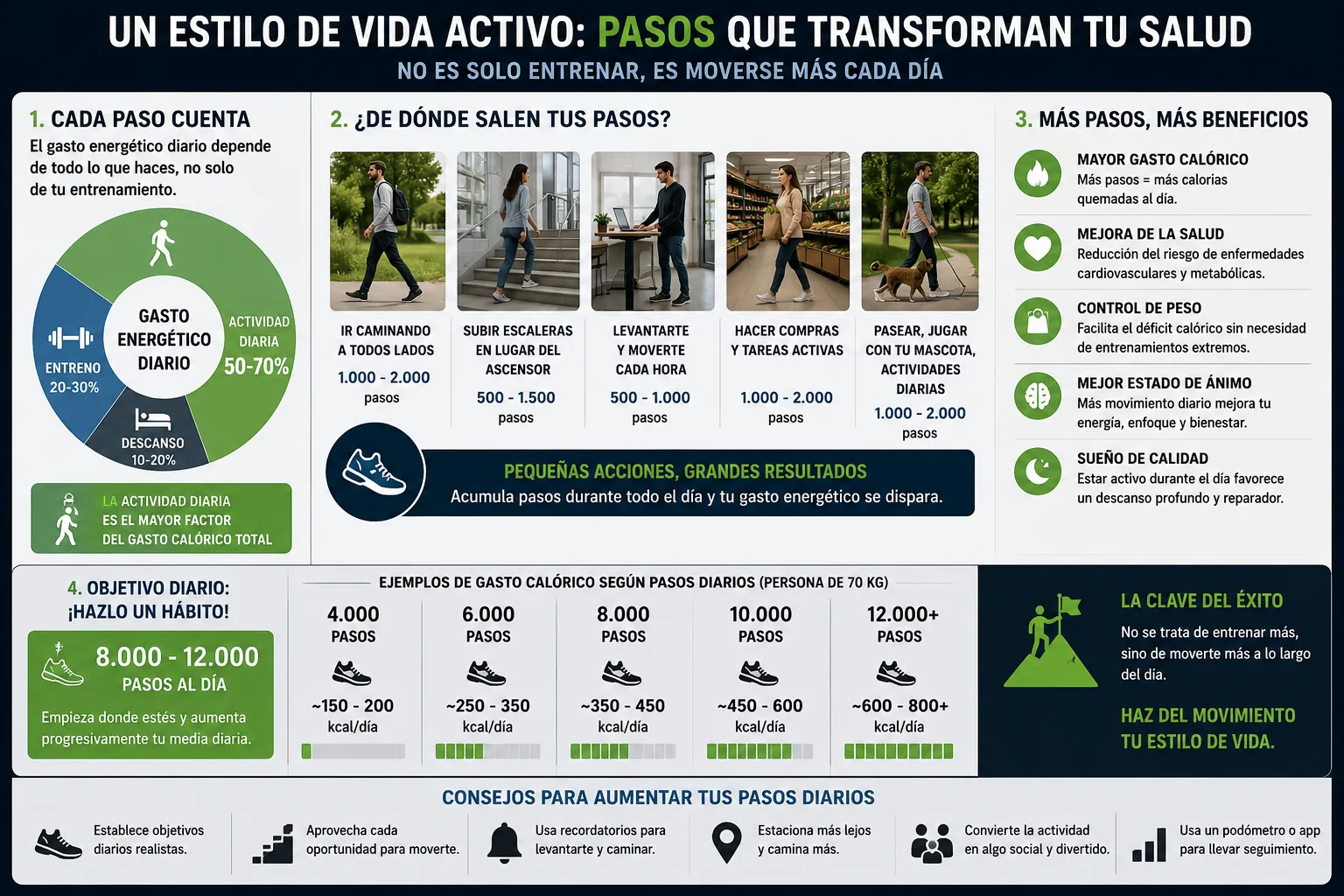
- Sedentary person: 2,000–3,000 steps/day
- Active person: 10,000–15,000 steps/day
This can represent a difference of:
- 300 to 800 kcal daily
In one week:
- 2,100 to 5,600 kcal
In one month:
- up to 24,000 kcal difference
👉 This is equivalent to several kilos of body fat without changing training.
That's why walking is so powerful: it doesn't add stress, it adds invisible energetic volume.
7. Does walking really lose weight?
Yes, but under clear conditions.
Walking loses weight if:
- There is a sustained caloric deficit
- 8,000–12,000 steps per day are achieved
- Weekly record is maintained
- It is not compensated by eating more
Walking DOES NOT lose weight if:
- It is used as an excuse without controlling the diet
- The volume is low and sporadic
- There is unconscious food compensation
👉 The decisive factor is not walking, but the entire system.
8. Physiological adaptations when walking
Walking regularly generates profound adaptations:
1. Mitochondrial adaptation
Increases mitochondrial density → better use of fats.
2. Improved insulin sensitivity
The muscle captures glucose more efficiently.
3. Metabolic flexibility
The body alternates better between fat and glucose.
4. Reduction of physiological stress
Less chronic activation of the cortisol-adrenal axis.
5. Improvement of venous return and circulation
Especially important in sedentary people.
9. Walking does not directly “burn fat” (critical nuance)
During walking:
- A higher proportion of fat is used as fuel
But this does NOT mean you automatically lose more body fat.
Fat loss depends on:
Total weekly energy deficit
You can oxidize fat during exercise and still not lose fat if you overeat.

11. The most common mistake: thinking in isolated calories
One of the most serious errors is this:
“I have walked for 1 hour, therefore I have burned fat”
The problem is that:
- The body unconsciously compensates
- Intake can increase without realizing it
- Total NEAT can be reduced outside of exercise
- The weekly balance rules
Real example:
- Walk: -300 kcal
- Extra snack: +400 kcal → Result: hidden surplus
12. Advanced Strategy: How to Use Walk Correctly
For walking to be really effective:
Base objective
- 8,000–12,000 steps daily
Ideal distribution
- 10–15 min after each meal
- 30–60 min main walk
- Incidental movement during the day
Optimal speed
- 5–6.5 km/h (efficient sustainable zone)
Progression
- Increase steps weekly (not abruptly)
- Add progressive incline
13. Walking after eating (underused metabolic weapon)
This habit has very specific effects:
- Reduces postprandial glucose peaks
- Improves insulin sensitivity
- Reduces post-meal lipid storage
- Improves digestion and feeling of energy
Even 10 minutes can make a metabolic difference.
14. Why people stop losing fat even if they walk
Common stagnations are explained by:
- Unconscious reduction in movement outside of walking
- Increased compensatory intake
- Metabolic adaptation (lower total expenditure)
- Lower actual intensity over time
Solutions:
- Monitor real steps, not estimates
- Progressively adjust the volume
- Control diet with real precision
- Maintain weekly consistency

16. Real Comparison: Walking vs Running vs Strength
Walk
- Maximum sustainability
- Low fatigue
- High cumulative volume
Run
- More calories/minute
- Increased physiological stress
- Lower long-term adherence
strength training
- Maintains muscle mass
- Improves body composition
- Does not replace NEAT
Conclusion:
The best method is not the most intense, but the most sustainable over time.
17. Time needed to see results
If executed correctly:
- Week 1–2: energy improvement and bloating reduction
- Week 3–4: Initial visible fat loss
- Week 6–12: clear changes in body composition
- Later months: stable transformation
But the most important thing:
Walking does not produce rapid changes, it produces cumulative changes.
18. Final conclusion
Walking does lose weight, but not as “exercise”, but as a tool to regulate daily energy expenditure.
Its real power is in:
- Increase NEAT massively without NEAT fatigue
- Allow sustainable calorie deficit
- Improve metabolic efficiency
- Facilitate long-term adherence
- Integrate into daily life without friction
Fat loss does not depend on a specific session, but on the complete system that you repeat for weeks.
In practical terms, walking does not win by intensity, it wins by accumulated perseverance.