When a person starts training, they usually worry about choosing the best exercises, the ideal repetitions or the right weight. However, there is an aspect that often goes unnoticed and that can greatly influence the results: the order in which you perform the exercises.
Does it matter whether you start with the bench press or with the flyes? Is it better to do squats or leg extensions first? Is it better to leave the abs for last? These are very common questions and the answer is yes, the order of the exercises can make an important difference in both performance and progress.
This does not mean that there is a single correct order valid for all people. The best sequence will depend on your objectives, your experience, the type of training and the exercises you are going to do. Even so, there are general principles backed by scientific evidence that can help you organize your sessions in a much more efficient way.
Understanding how fatigue influences performance is the first step to understanding why the order of exercises matters much more than it seems.
Why does the order of the exercises influence?
Each exercise you perform produces a certain level of fatigue.
That fatigue can be:
- Muscular.
- Nervous.
- Cardiovascular.
- Mental.
As training progresses, the ability to generate force progressively decreases.
This means that you will usually perform better in the first exercises of the session than in the last ones.
For example, if you start training with heavy squats, you will be able to use more weight and do more repetitions than if you do them after several leg exercises.
The explanation is simple.
When you start training:
- Your energy reserves are more complete.
- The nervous system is fresh.
- The concentration is higher.
- The muscles have not yet accumulated fatigue.
That is why the performance is usually higher.

The most important rule: prioritize what matters most to you
There is a recommendation that practically all coaches share.
The most important exercises should be done at the beginning of the session.
Because?
Because that's when you can make them with higher quality.
If your main objective is to improve the squat, it is logical to place it at the beginning of the training.
If you want to progress in the bench press, it should also occupy one of the first positions.
And if you're especially looking to develop your back, it probably makes sense to start with pull-ups or rows before secondary exercises.
The body always performs better when it is not yet fatigued.
That's why the order should reflect your priorities.
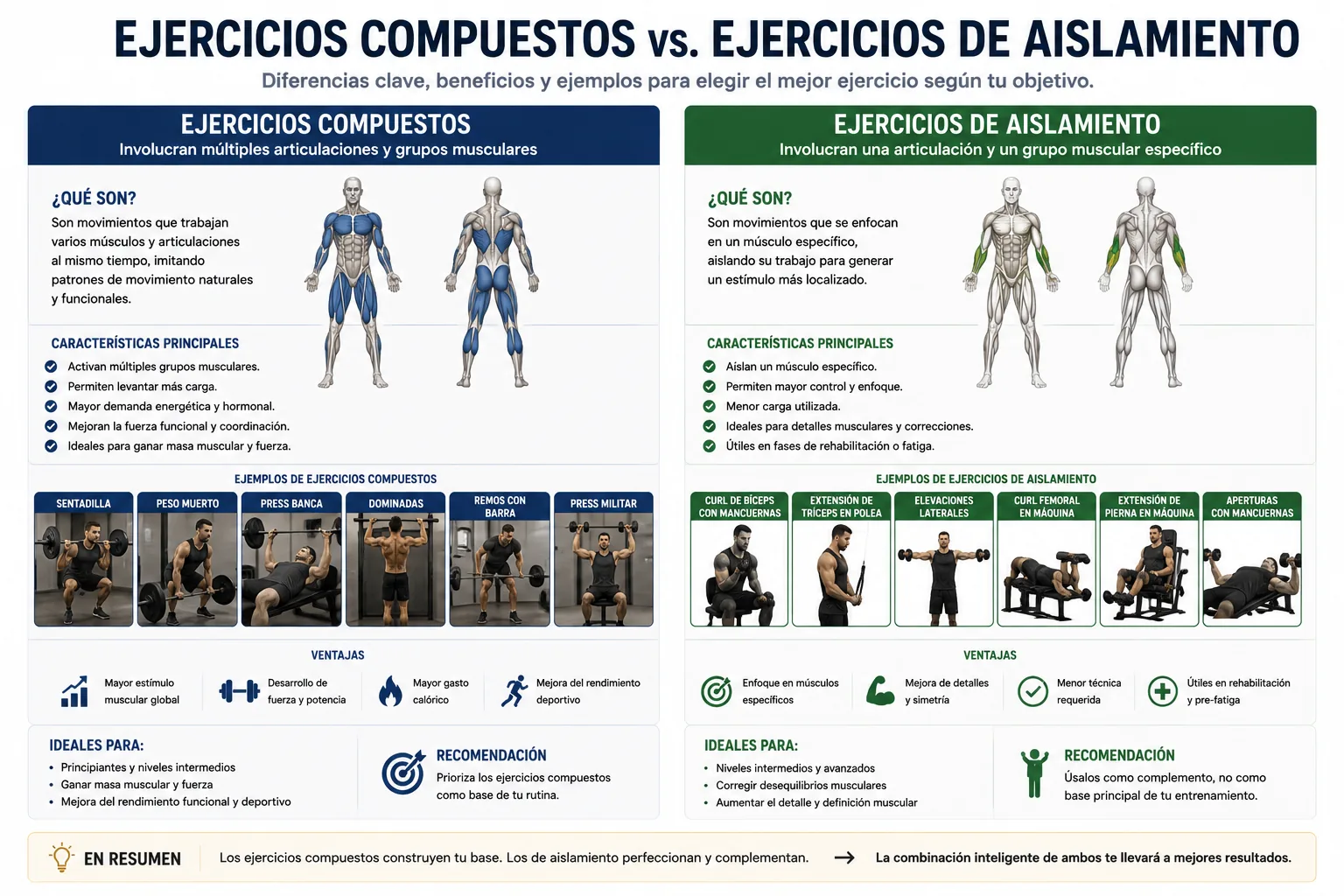
Compound exercises before isolation exercises
In most routines there is a very useful rule.
First the compound exercises.
Then the isolation exercises.
Compound exercises involve multiple joints and large muscle groups.
For example:
- Squat.
- Dead weight.
- Bench press.
- Military press.
- Pull-ups
- Rowing.
These movements allow large loads to be moved and require good coordination.
As a consequence, they generate a lot of fatigue.
Isolation exercises, on the other hand, mainly work a specific muscle.
For example:
- Biceps curl.
- Triceps extension.
- Lateral raises.
- Femoral curl.
- Quadriceps extension.
As they produce less overall fatigue, they are usually placed after the main movements.
What happens if you change the order?
Nothing negative always happens.
But training priorities do change.
Imagine a chest session.
Option A:
- Bench press.
- Incline press.
- Openings.
Option B:
- Openings.
- Bench press.
- Incline press.
In the first option you can use more weight in the bench press.
In the second you will arrive at the press with your chest partially fatigued, so you will probably lift less load.
This can be useful if your goal is to increase the stimulus on the chest by reducing the participation of other muscles.
But if you're looking to improve bench press strength, it usually won't be the best strategy.
Does the order matter for gaining muscle?
Yes, although probably less than many people believe.
If the total training volume is sufficient, you can gain muscle mass with different exercise orders.
However, the muscle you train first usually receives a higher quality stimulus because you are able to work with more intensity and better performance.
Therefore, if you want to prioritize a lagging muscle group, a widely used strategy is to place it at the beginning of the session.

What does the scientific evidence say?
Research shows that exercises performed at the beginning of the session usually present:
- Greater force production.
- More reps completed.
- Greater speed of execution.
- Better technical quality.
Furthermore, the muscle trained first usually obtains greater adaptations when there is a clear difference in priority.
This reinforces the idea of organizing the routine according to personal objectives.
And the abs?
Many people start their training by doing various abdominal exercises.
In some cases this may be a mistake.
The core participates in movements such as:
- Squat.
- Dead weight.
- Military press.
- Rowing.
If you arrive to these exercises with a very fatigued abdomen, stability may decrease.
That is why it is usually more advisable to leave specific core work for the final part of the session, unless that is precisely your main objective.
What about cardio?
It also depends on the objective.
If your priority is gaining strength or muscle, it's usually best to do cardio after weight training.
If you do an intense running session before lifting weights, your performance will likely decrease.
On the other hand, if your main goal is to improve cardiovascular endurance, it may make sense to reverse that order.
Planning should always fit the main priority of training.
Once you understand that performance progressively decreases as the session progresses, it becomes much easier to understand why the order of the exercises can influence the results. It's not about following a rigid rule, but about organizing each workout so that most of your energy is allocated to what you really want to improve.
How to organize a routine intelligently
Although each plan can vary, there is a structure that usually works very well for most people.
1. Warm-up
Before starting the loads it is essential to prepare the body.
A good warm-up should include:
- Mobility of the joints that you are going to use.
- Muscle activation.
- Approach series with little weight.
- Progressive increase in intensity.
This improves performance and reduces the risk of injury.
2. Main exercises
After the warm-up come the most important movements of the session.
They are normally compound exercises such as:
- Squat.
- Dead weight.
- Bench press.
- Pull-ups
- Military press.
- Rowing.
This is where you should focus most of your energy and attention.
It is time to work with the highest loads and with the best possible technique.
3. Secondary exercises
Once the main movements are completed, it is the turn of exercises that are still important, but generate less overall demand.
For example:
- Incline press.
- Hip thrust.
- Pulls.
- Press.
- Funds.
These help add training volume and continue to stimulate major muscle groups.
4. Isolation exercises
At the end of the session, exercises aimed at specific muscles are usually placed.
Among them:
- Biceps curl.
- Triceps extensions.
- Lateral raises.
- Femoral curl.
- Twins.
- Abs.
As they require less coordination and allow working with relatively lower loads, they can be performed even when there is already some accumulated fatigue.

When is it appropriate to break the rules?
Although the traditional order is usually the most recommended, there are situations in which modifying it can be beneficial.
To prioritize a lagging muscle
If you notice that one muscle group is progressing more slowly than the rest, you can place it at the beginning of the workout.
For example, if your shoulders develop worse than your chest, it may be interesting to train them before the bench press.
This way they will arrive fresh and will be able to receive a higher quality stimulus.
In specific phases of hypertrophy
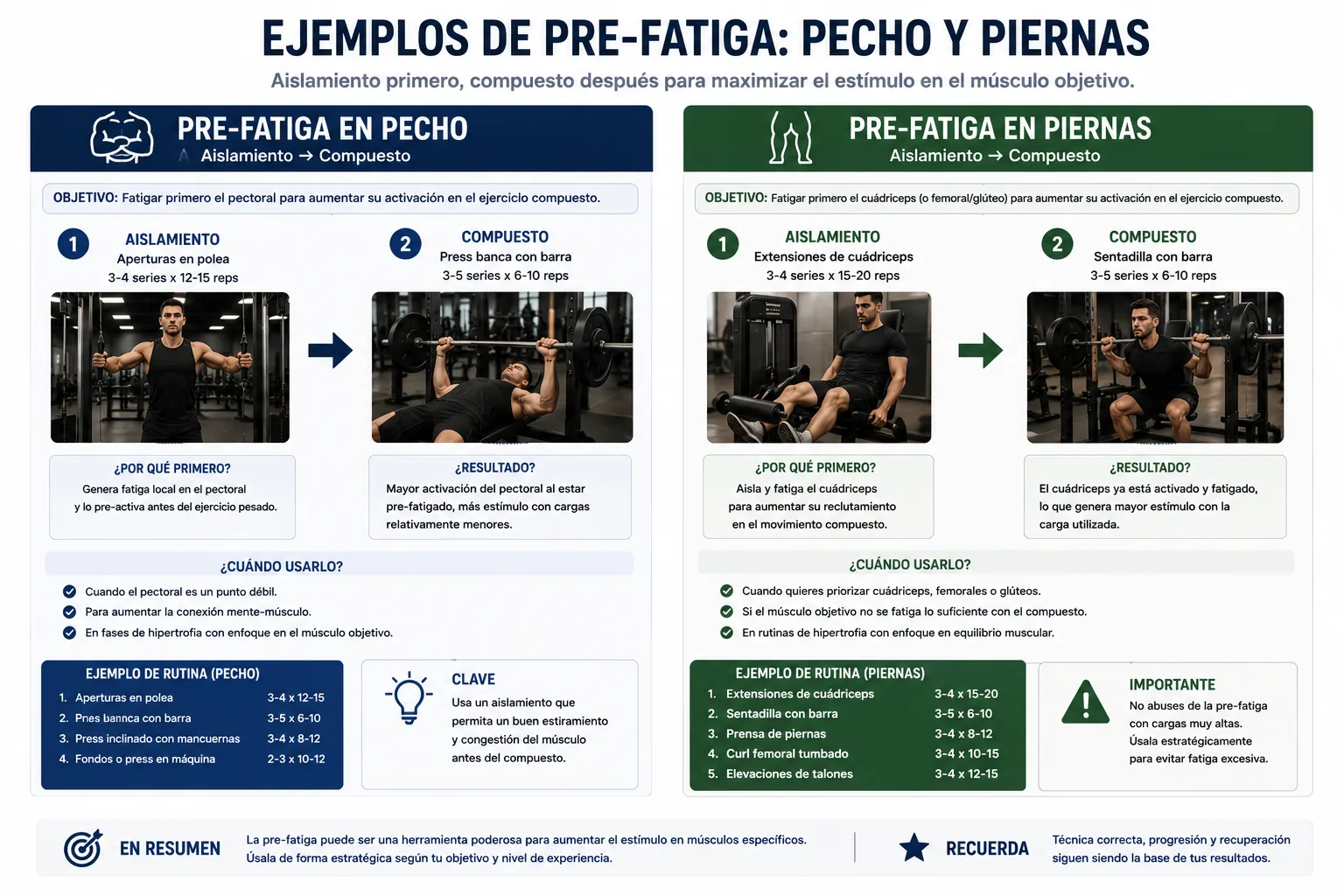
Some coaches use so-called pre-fatigue.
It consists of first performing an isolation exercise and then a compound exercise.
For example:
- Openings.
- Bench press.
EITHER:
- Quadriceps extension.
- Squat.
The idea is to pre-fatigue the target muscle so that it participates more during the compound exercise.
Although it can be useful in specific situations, it is not usually the best strategy to improve strength.
To avoid discomfort or injury
For some people it may be advisable to modify the order to accommodate physical limitations.
For example, if an exercise causes discomfort when performed at the beginning of the session, it may work better after other movements that prepare the joint.
In these cases it is always advisable to have a professional assessment.
Frequent errors
Always start with the exercises you like the most
Many people organize training according to their preferences.
However, if you always start with your favorite exercise, other muscle groups can constantly take a backseat.
Over time this can create imbalances.
Fatigue before complex movements
Doing too many sets of sit-ups, intense cardio, or isolation exercises before a heavy squat often reduces performance.
The quality of the main moves should always be a priority.
Changing the order every week for no reason
It is not necessary to continually modify the exercise sequence.
Maintaining a stable structure makes it easier to measure progress and apply progressive overload more accurately.
Thinking that there is only one perfect order
There is no universal routine.
The best order will always depend on your goals, your level of experience, and your individual needs.
What if you train at home?
The same principles remain valid.
You will simply have to adapt to the available material.
For example, if you only have some dumbbells and an elastic band, it is still advisable to start with the most demanding exercises and leave those that require less overall effort for last.

So does the order of the exercises matter?
Yes, and much more than many people believe.
The order determines which muscles receive the best stimulation, how much weight you are able to move, how many repetitions you can perform, and how fatigue evolves throughout the session.
It doesn't mean that changing the order occasionally will ruin your results, but organizing the exercises intelligently allows you to get the most out of each workout.
In most cases, the most effective strategy is to start with the most important movements, continue with secondary exercises, and finish with isolation exercises.
Conclusion
The order of the exercises is not a simple organizational detail, but a training variable that can influence performance and long-term progress. The first exercises of the session are always performed with a higher level of energy, concentration and ability to produce force than the last ones, so it is advisable to reserve that moment for what you really want to improve.
If your goal is to increase strength, basic exercises should be at the top. If you're looking to build a muscle that's been lagging behind, place it at the beginning of your workout to give it priority. And if you simply want a balanced routine, follow a logical structure that goes from the most demanding movements to the most specific ones.
In short, there is no perfect universal order, but there is a principle that almost always works: do what matters most first. Applying this simple idea can help you train with higher quality, make better use of your energy, and progress more steadily over months and years. Often, small changes like rearranging a routine produce better results than adding more sets or training for longer.